Win vs Haminhtien2024 (534)
| Opening: St. George Defence (A40) | Result: 1-0 (Checkmate) | Time Control: 3 min + 2 sec increment (Blitz) | Rated |
Game Overview
This was the win I really needed. It had been a tough start to chess today. I hadn’t really played much all week, just my ongoing daily games and some puzzles. Work was too busy and stressful to concentrate on chess, and Saturday was taken up looking at houses. So when Sunday rolled around I was excited to get some games in but also a little nervous about how rusty I would be. I was right. I lost four bullet games in a row, then switched to 15+10 rapid and lost two more in a row. Stupid blunders and a mouse slip. It really wasn’t my day.
I took a break, had a coffee, sat outside for a bit, tried to regain some composure and avoid tilt. Then I thought I’d try again, this time 3+2 blitz. And this was the win I really needed, otherwise this would’ve been my worst week in chess ever.
The Opening (Moves 1-8)
1. d4 a6 2. Nf3 c6 3. e3 d5 4. Bd3 Bg4
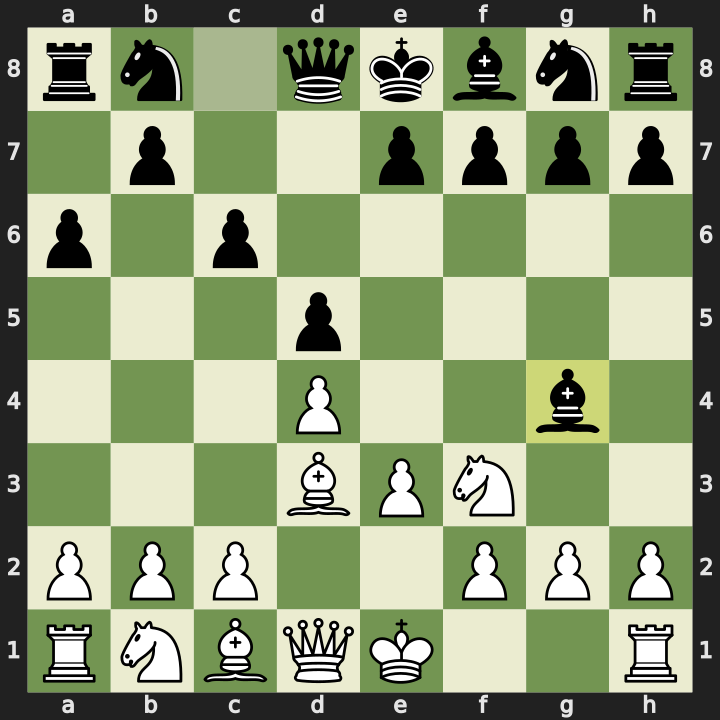
The game started pretty calmly with my usual Queen’s pawn opening heading for the Colle-Zukertort. My opponent played 1…a6, which chess.com tells me is the St. George Defence. I’ve never come across that before so I’ll have to read up on it. Everything was pretty calm. Black parked a bishop on g4, pinning my knight to the queen, but didn’t seem to have any real intention beyond the pin for the moment.
5. O-O e6 6. Nbd2 c5 7. b3 Nc6 8. Bb2 Nf6
The Bishop Pin and a Recapture Mistake (Moves 9-14)
9. h3 Bxf3 10. Qxf3
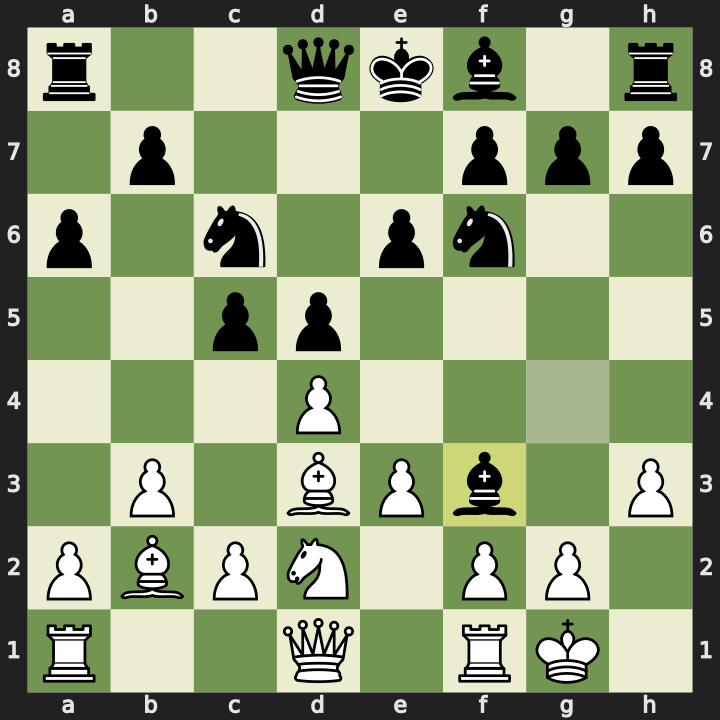
I poked the bishop with my pawn, prompting it to take my knight. I think I made a mistake here by taking back with my queen. I was so focused on the fact that the bishop was attacking my queen that I immediately took the attacker. But I think it would’ve been better to retake with my knight on d2. I usually put it there for exactly this reason: so it can replace the knight on f3 if necessary.
10…cxd4 11. exd4 Bb4 12. Qe3 Bxd2 13. Qxd2 Ne4 14. Qf4
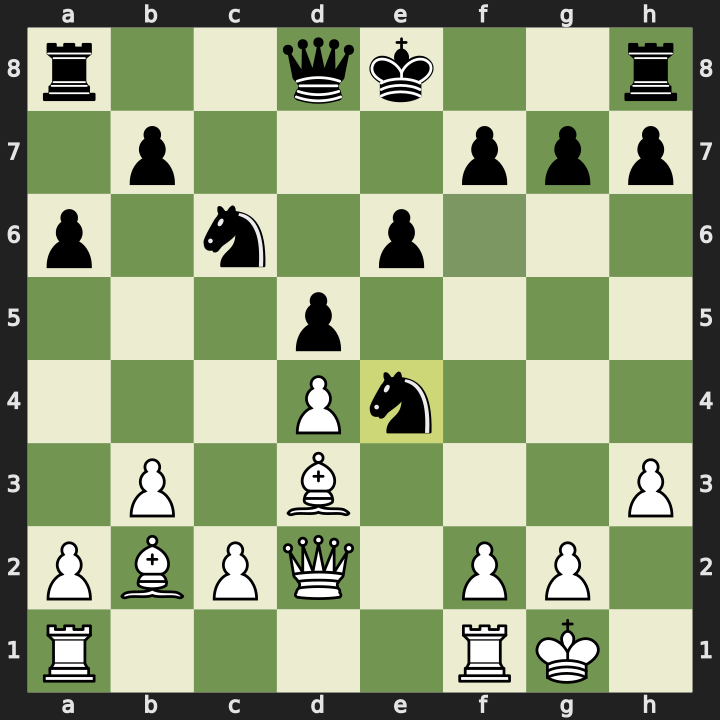
Black threatened my knight on d2 with the bishop on b4 and I defended by sliding my queen over to e3, thinking this would also allow me to push my f-pawn and bring my rook out later. Black takes on d2 and I take back with the queen.
Black hops the knight into e4, attacking my queen. I’m really not feeling like exchanging my bishop for the knight here. It’s not really threatening anything else, so I just moved my queen up to f4 where it can eye the e5 square.
Rooks Enter the Game (Moves 15-21)
14…O-O 15. Rae1
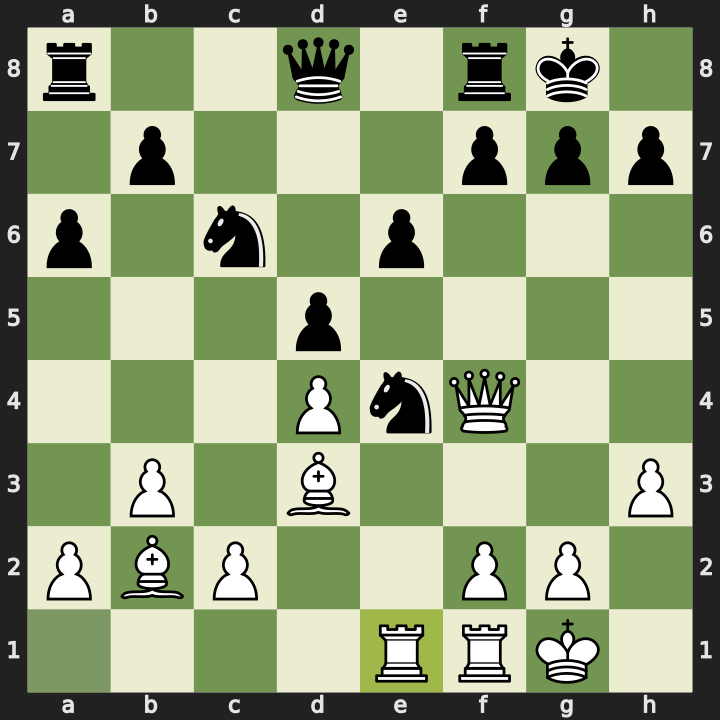
Black castles and I bring in my a-rook, looking for a way to break through Black’s defences.
15…f5 16. Re3 Nb4 17. a3 Nxd3 18. cxd3
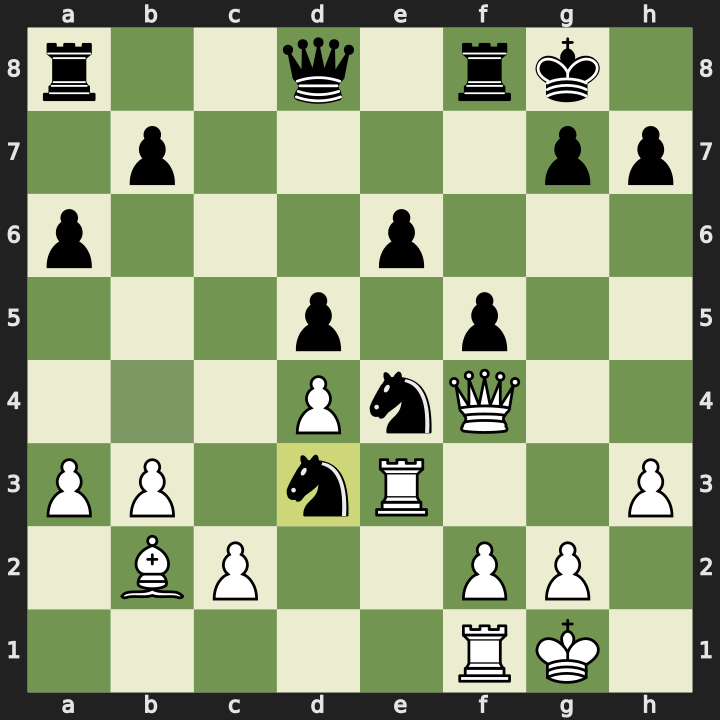
Black brings the other knight to b4, which I poke with my pawn on a3, allowing it to take my bishop on d3. I take back with my pawn. I thought if nothing else this would also prompt the knight on e4 to move, possibly allowing me to get more of an attack going on the kingside.
18…Nd2 19. Rfe1 Nxb3
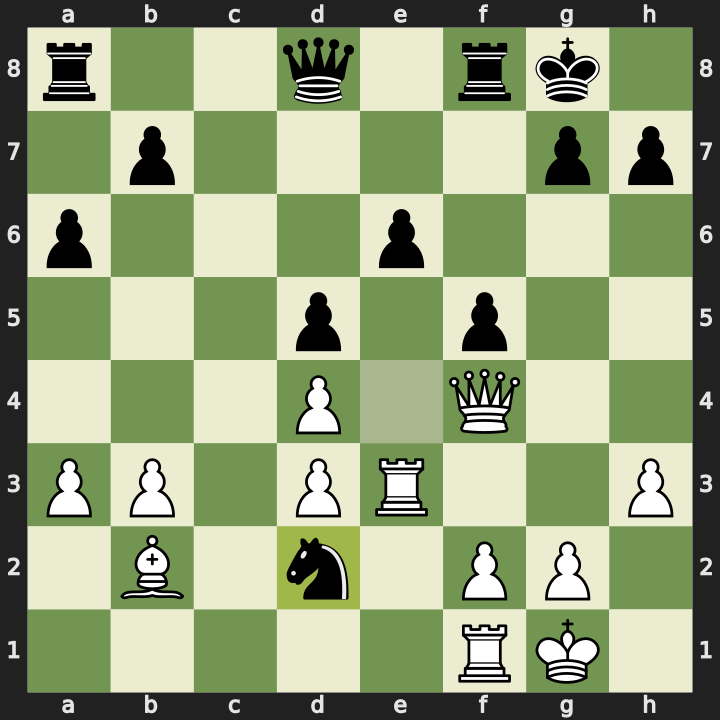
Black’s knight hopped into d2, threatening my rook. I slide it over to the e-file, giving me doubled rooks both pointing at a backward pawn on e6. This looks pretty good for me. Black picks up the b3 pawn and I pick up the e6 pawn.
20. Rxe6
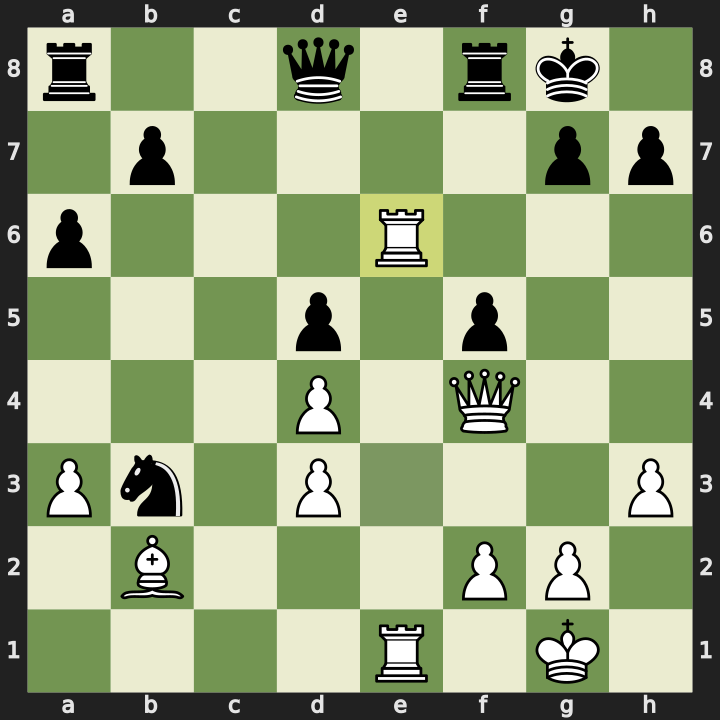
I’m not really concerned about b3. The attack is happening on the kingside. If anything, it’s good to draw the knight away from the defence of the king.
20…h6 21. R1e5
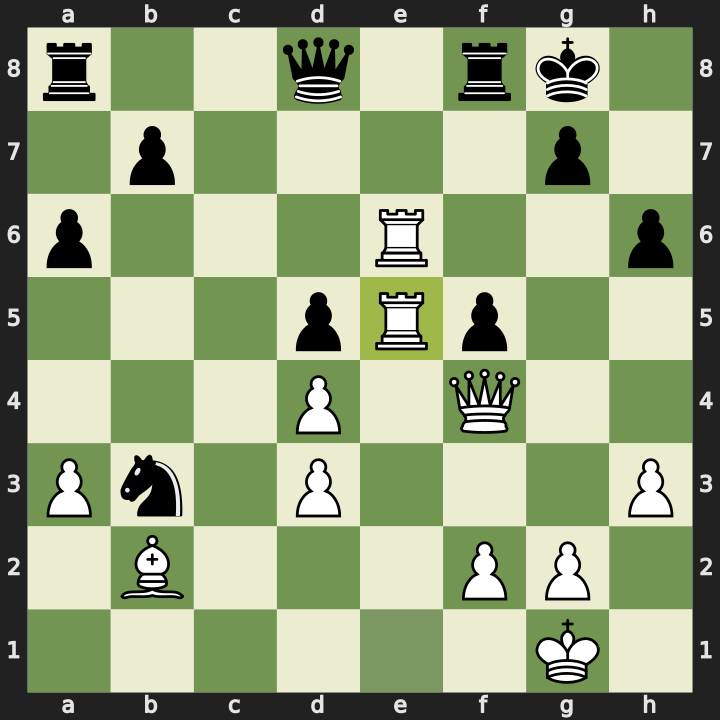
I bring my second rook up, double-attacking d5 and f5. I’m thinking I can pick up the f5 pawn, forcing a rook exchange while Black’s other rook is stuck on a8 blocked by the queen. There might be a chance for me here.
The Blunder and the Checkmate (Moves 22-27)
21…Qd7 22. Qg3 Nxd4
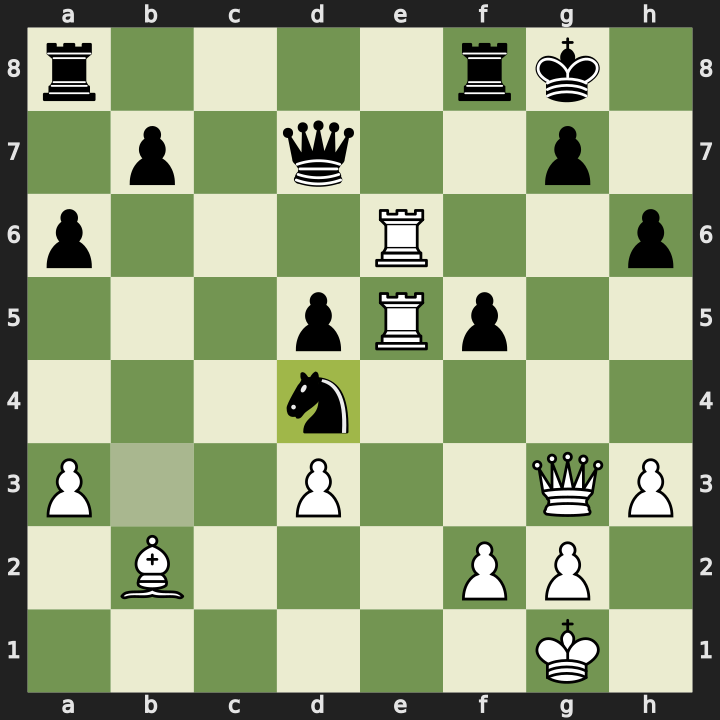
Black blunders, or at least makes a mistake, taking a pawn on d4 that was protected by my bishop.
23. Bxd4 Qa4 24. Bb2 f4 25. Qg4 Qc2 26. Re2
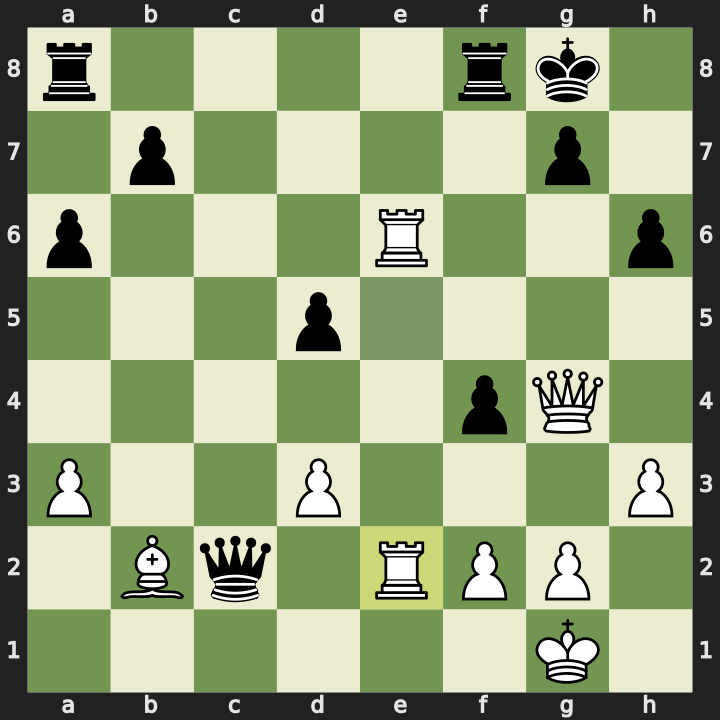
Black brings the queen in to try and threaten some of my pieces, and when they bring the queen to c2, I drop my rook back to e2. This was initially to defend my bishop while attacking the queen. My queen defends my rook, my rook defends my bishop. Everything’s looking pretty good here.
26…Qxd3 27. Qxg7#
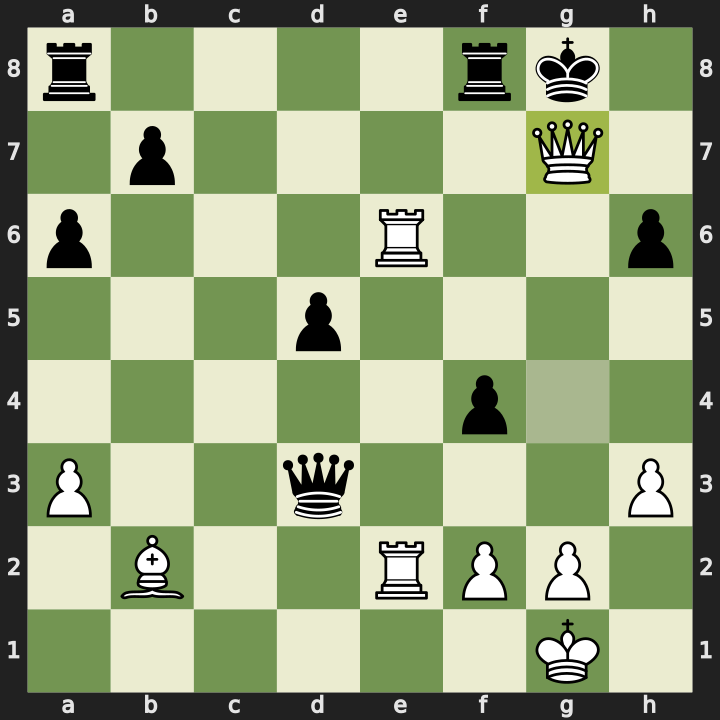
Black picks up a pawn on d3, and that’s when I noticed they haven’t defended their king adequately. With my bishop on the long diagonal and my queen on the g-file, that’s mate in one. Moving my rook back down to e2, opening up the diagonal for my bishop, ended up being an unexpectedly excellent move. I pick up the pawn on g7 and it’s checkmate.
Engine Review
The engine agrees: on move 9, taking the bishop on f3 with the knight on d2 is the way to go, not the queen.
On move 13, the engine likes taking the knight on e4 with my bishop on d3 when it first hops in. I guess that wouldn’t have been so bad given that later in the game that bishop was taken by a knight anyway. But at the time I really liked the idea of holding onto it in case it could be used to target h7 later.
After 20. Rxe6, the engine prefers pushing the rook up to e7 rather than bringing the second rook in to e5 on move 21. That makes sense: it’s setting up a mating threat on g7 with Qg3 followed by Qxg7 checkmate.
The engine basically scores moves 21-26 as inaccuracies because that mating threat on g7 could’ve been set up at any time just by pushing the rook from e6 to e7. But I’m very happy that none of my moves were scored as a mistake or blunder or even a miss. It’s not the way the engine wanted to play it, but none of it was bad. And the most important opportunity, the mate in one on move 27, was the one that I did see.
Reflections
What went well:
- Staying calm and defending against attacks by single pieces. Black tended to send pieces in one at a time, charging in with the early bishop, then the knights, then the queen. They never quite coordinated their pieces to be a real threat. I came across the idea this week that the magic number of pieces for an attack is three, and Black never got close to that. I hope the fact that I’m noticing this is a sign that my chess is improving.
- Not worrying too much about material. I tried to focus on looking for checkmate opportunities. Something I’ve noticed about my game in the last month or so is appreciating the power of checkmate, or even the threat of checkmate, to force opponents into giving up material.
- Getting back on the horse after a brutal losing streak. Coffee break, composure, and a fresh game type worked.
What to work on:
- Recapture decisions. Taking with the queen on f3 when the knight on d2 was sitting there for exactly that purpose. Need to pause and ask “what else can take here?” before automatically recapturing with the attacked piece.
- Keep an eye out for mating threats. The Qxg7 checkmate was available much earlier if I’d pushed the rook to e7 to set it up.
Full PGN:
1. d4 a6 2. Nf3 c6 3. e3 d5 4. Bd3 Bg4 5. O-O e6 6. Nbd2 c5 7. b3 Nc6 8.
Bb2 Nf6 9. h3 Bxf3 10. Qxf3 cxd4 11. exd4 Bb4 12. Qe3 Bxd2 13. Qxd2 Ne4 14.
Qf4 O-O 15. Rae1 f5 16. Re3 Nb4 17. a3 Nxd3 18. cxd3 Nd2 19. Rfe1 Nxb3 20.
Rxe6 h6 21. R1e5 Qd7 22. Qg3 Nxd4 23. Bxd4 Qa4 24. Bb2 f4 25. Qg4 Qc2 26.
Re2 Qxd3 27. Qxg7# 1-0
Further Reading
- St. George Defence (Wikipedia) - background on the unusual 1…a6 defence my opponent played.