Two Wins vs Albertp57 (977)
| Event: 91st Chess.com Daily Tournament (1001-1200), Round 1 | Time Control: 3 days/move (Daily) | Rated |
Two games against the same opponent in the same tournament round. Both ended in resignation after 13 and 15 moves after my opponent got into a losing position from opening tactics. In both games I spotted tactics, played solid openings and got into winning positions quickly.
Game 1: Win as White (Catalan-style vs King’s Indian)
| Opening: Catalan-style (d4, Nf3, g3, Bg2, c4) | Result: 1-0 (Resignation) | Opponent Rating: 977 |
The Game
1. d4 d5 2. Nf3 Nf6 3. g3 g6 4. Bg2 Bg7 5. c4 c6 6. O-O Nbd7 7. cxd5 Nxd5 8. e4 N5f6 9. e5
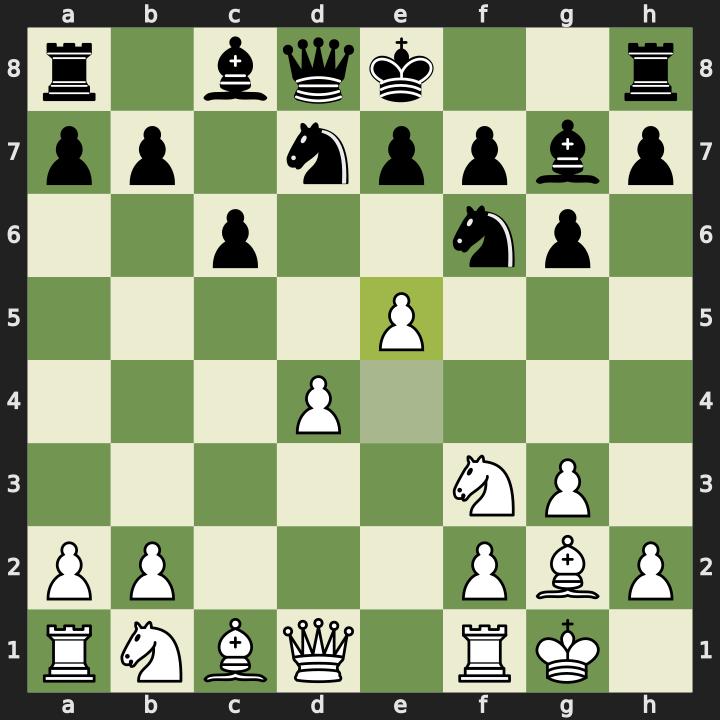
My opponent went into a King’s Indian Defence. This is an opening I enjoy playing as Black myself but I’m not actually very good at playing against as White. I recently learned that my favourite Colle system isn’t that good against the King’s Indian, particularly because you can’t get a knight on e5 and a bishop on d3 aiming at the kingside because of Black’s strong fianchetto setup. But I knew that grabbing space in the centre, pushing c4, and getting the queen and bishop lined up on the c1-h6 diagonal are all things that I find difficult to play against when I’m playing the King’s Indian as Black, so that’s what I went for in this game.
9…Nd5 10. Nc3 O-O 11. Nxd5 cxd5 12. Bf4 g5
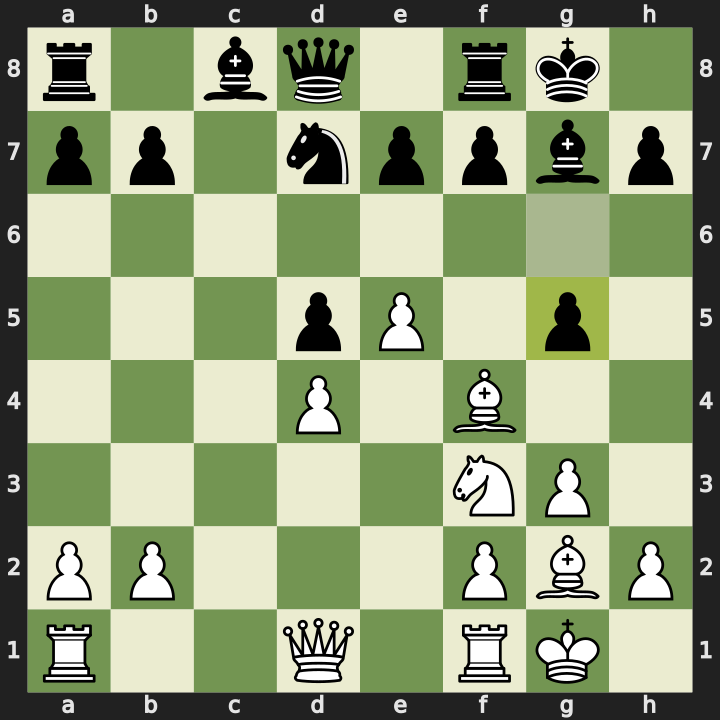
Black made an early mistake pushing g5 to attack my bishop on f4. This just weakens the squares in front of the king and gave me a free pawn.
13. Bxg5 f6 14. Bf4 Rf7 15. e6
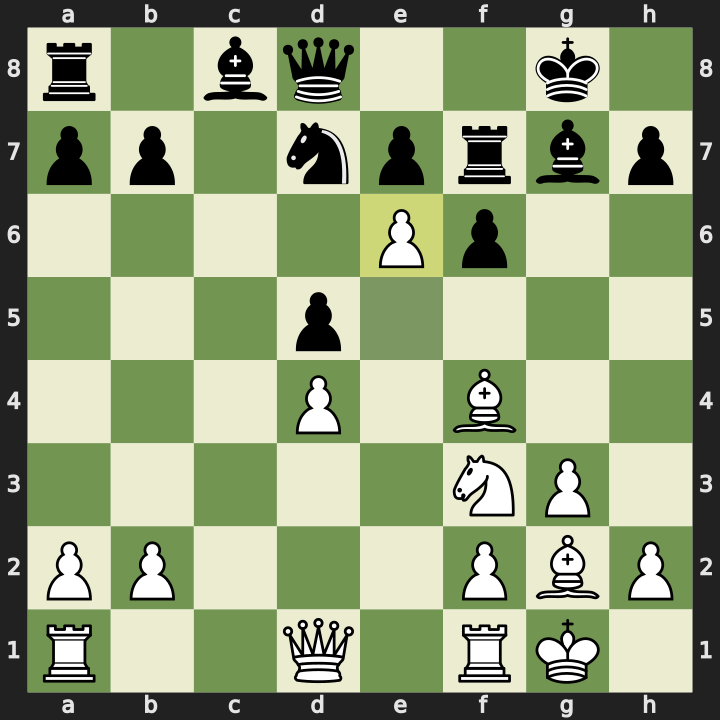
The next two moves from Black were also a bit puzzling. They pushed f6, perhaps to attack my pawn on e5, and then Rf7. Not sure what that was for, but it allowed me to play e6 forking the knight and rook. According to the engine it’s a +5.7 evaluation from that point. I’ll win the knight and then be up a piece and a pawn with a fairly easy time converting the win. Black resigned.
Full PGN:
1. d4 d5 2. Nf3 Nf6 3. g3 g6 4. Bg2 Bg7 5. c4 c6 6. O-O Nbd7 7. cxd5 Nxd5 8. e4
N5f6 9. e5 Nd5 10. Nc3 O-O 11. Nxd5 cxd5 12. Bf4 g5 13. Bxg5 f6 14. Bf4 Rf7 15.
e6 1-0
Game 2: Win as Black (Modern Defence)
| Opening: Modern Defence | Result: 0-1 (Resignation) | Opponent Rating: 980 |
The Game
1. e4 d6 2. Bc4 g6 3. Nf3 Nf6 4. d4 Bg7 5. h3 Nxe4 6. Qe2 d5 7. Bd3 Nc6 8. Bxe4 dxe4 9. Qxe4 Bf5
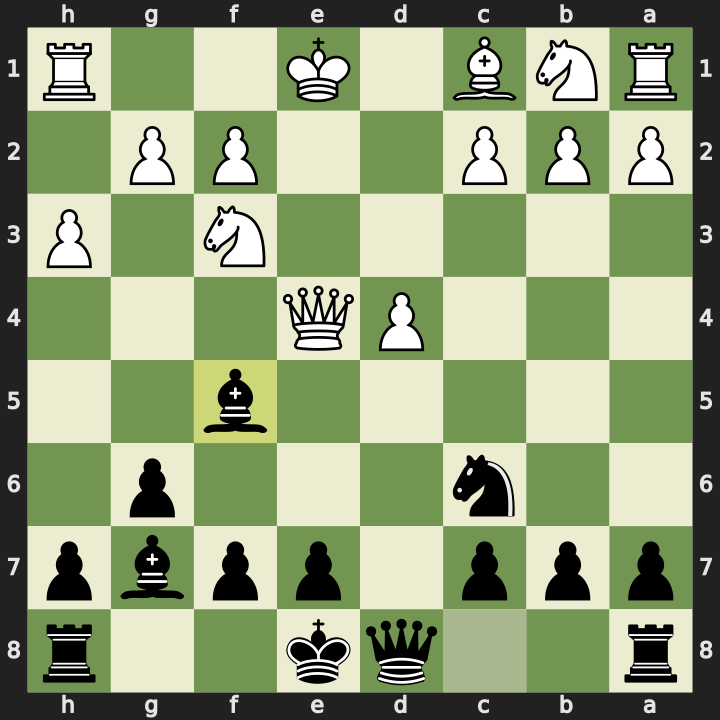
This started as a fairly normal King’s Indian Defence setup but White brought the queen out early, which gave me a target before they even had a chance to castle. Technically this was a Modern Defence.
On move 9 I got my light-squared bishop to f5, and from there I saw an opportunity to take advantage of the king that hadn’t castled and the fact that we’d opened up the centre.
10. Qe2 Nxd4 11. Qd2 Nxc2+
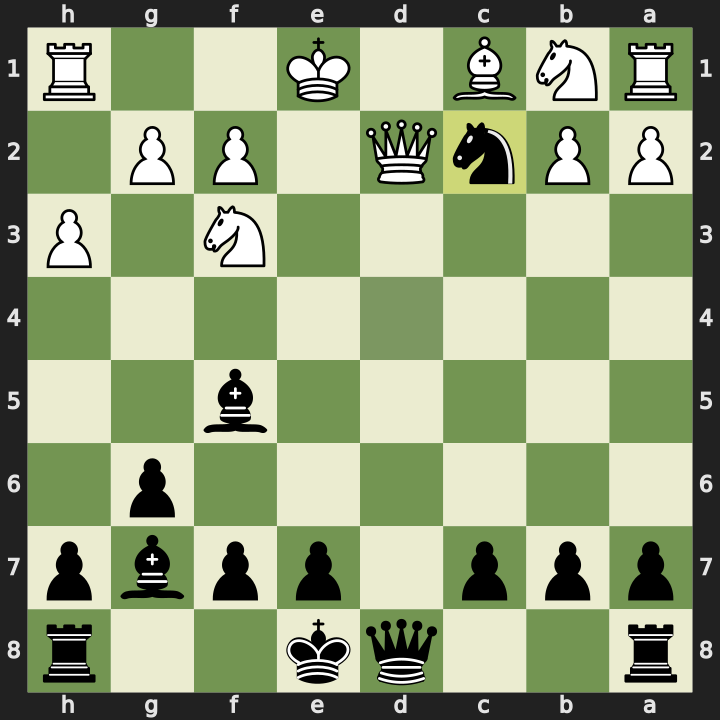
I manoeuvred my knight from c6 to d4 and then c2, checking the king and forking the rook on a1, supported by my bishop on f5. White had only the queen to take the knight and wasn’t interested in sacrificing the queen to keep the game going, so they moved the king up to e2.
12. Ke2 Qxd2+ 13. Nfxd2 O-O-O
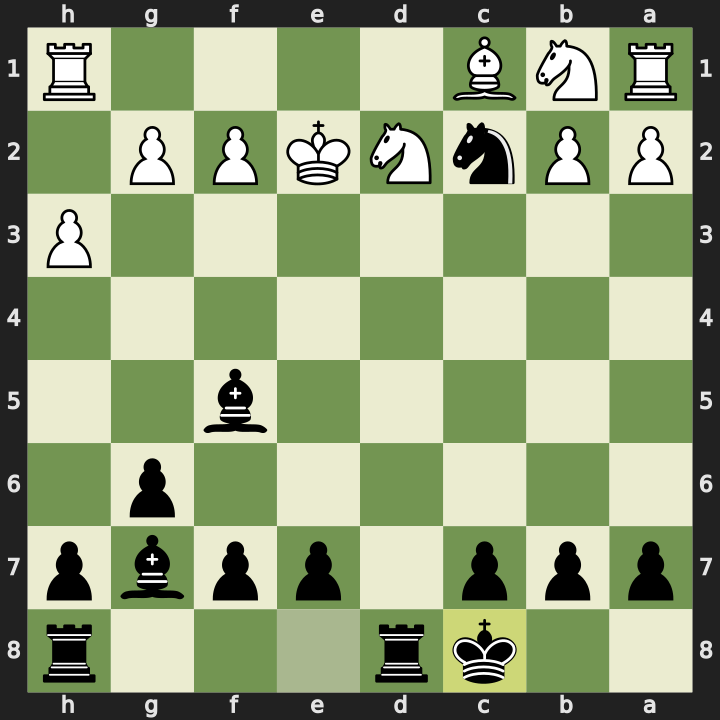
I saw a chance to immediately simplify the game and move into a winning position with Qxd2+ check. After Nfxd2, I castled long bringing another piece into the open file. White resigned. According to the engine it’s a -6.3 evaluation in Black’s favour. Even though there’s only a two-point material advantage, I was going to take a rook and escape with my knight intact.
According to the engine, White made mistakes on moves 4, 5, 8 and 11, so not a very accurate game from their side. I could have played even more aggressively, taking the pawn on e4 a move sooner before placing my bishop on g7. White’s main mistake in this game was bringing the queen out before castling. They could have castled way back on move 6. But once they had committed to Qe2, they didn’t have a lot of options.
Full PGN:
1. e4 d6 2. Bc4 g6 3. Nf3 Nf6 4. d4 Bg7 5. h3 Nxe4 6. Qe2 d5 7. Bd3 Nc6 8. Bxe4
dxe4 9. Qxe4 Bf5 10. Qe2 Nxd4 11. Qd2 Nxc2+ 12. Ke2 Qxd2+ 13. Nfxd2 O-O-O 0-1
Reflections
What went well:
- In both games I spotted tactics quickly and converted them cleanly.
- Game 1: Recognising that g5 weakened the kingside and spotting the e6 fork on the knight and rook.
- Game 2: Using the light-squared bishop to support the knight manoeuvre to c2 for the fork, and then simplifying immediately into a winning endgame.
What to work on:
- Nothing major from these two games. Keep spotting tactics and punishing early mistakes.