Win vs nikola0438 (819)
| Opening: Pirc Defence (B08) | Result: 0-1 (Resignation) | Time Control: 14 days/move (Daily) | Rated | Event: ForEverOne 2026, Round 1 |
Game Overview
This game felt like a long, evenly matched grind until a slight advantage towards the end gave me a chance at winning. It came down to king, pawns and a piece each, and after pinning a piece my opponent resigned. I was a little surprised because I thought there were still some chances left, but the analysis shows I was in a winning position. I’m glad I was able to play good moves and grind out the win.
The Opening (Moves 1-12)
1. e4 d6 2. d4 Nf6 3. Nc3 g6 4. Nf3 Bg7 5. Bg5 h6 6. Bxf6 Bxf6
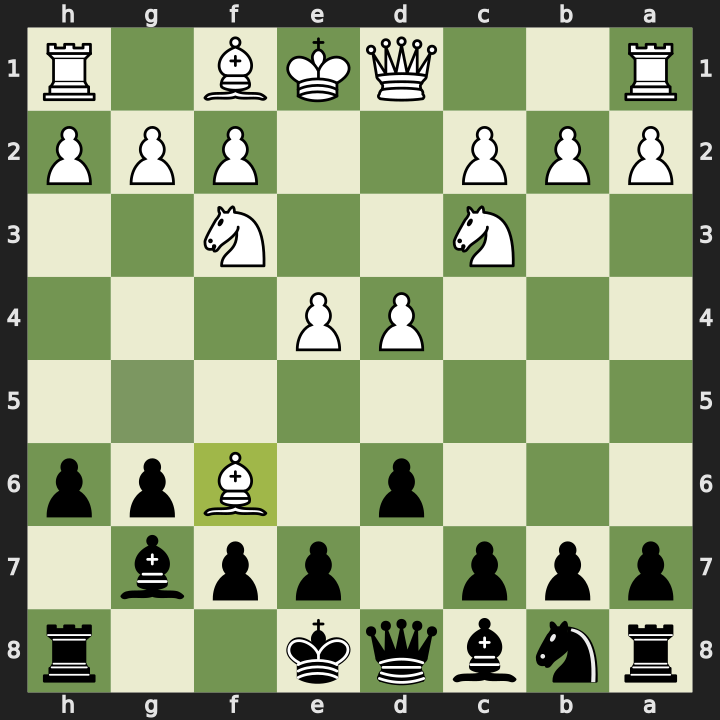
The opening was a Pirc Defence and White chose to take the knight on f6 with their dark-squared bishop. I think this is usually a mistake because it makes my own dark-squared bishop more powerful for the remainder of the game, but it did draw my bishop out to f6 making it more advantageous for White to play e5.
7. e5 dxe5 8. dxe5 Bg7
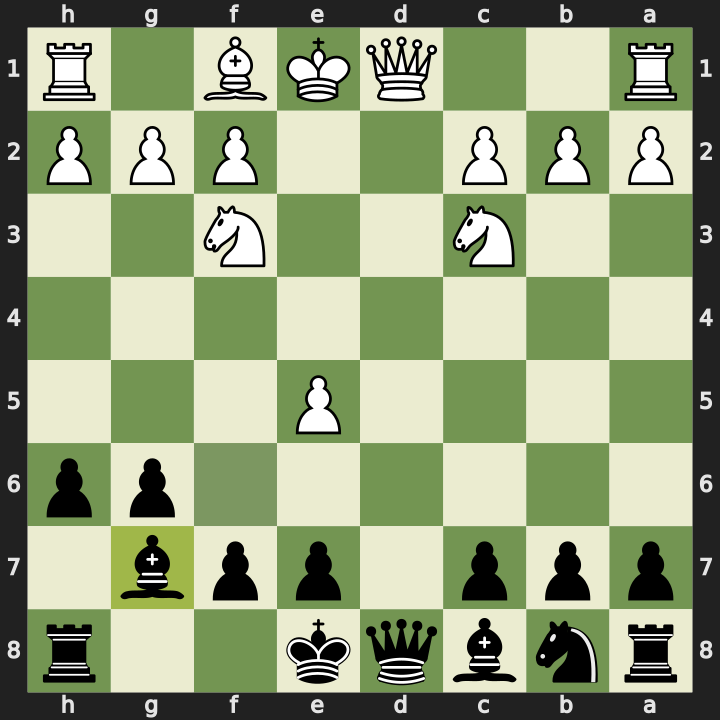
After trading the centre pawns I had a very careful decision to make. Do I take the queen on d1, inviting White to develop their rook to the centre and possibly bring their knight down to attack my queenside? Or do I simply retreat the bishop back to g7 and allow White to take the queen? Retreating the bishop was the right call.
9. Qxd8+ Kxd8 10. O-O-O+ Nd7 11. Bb5 c6 12. Ba4 Kc7
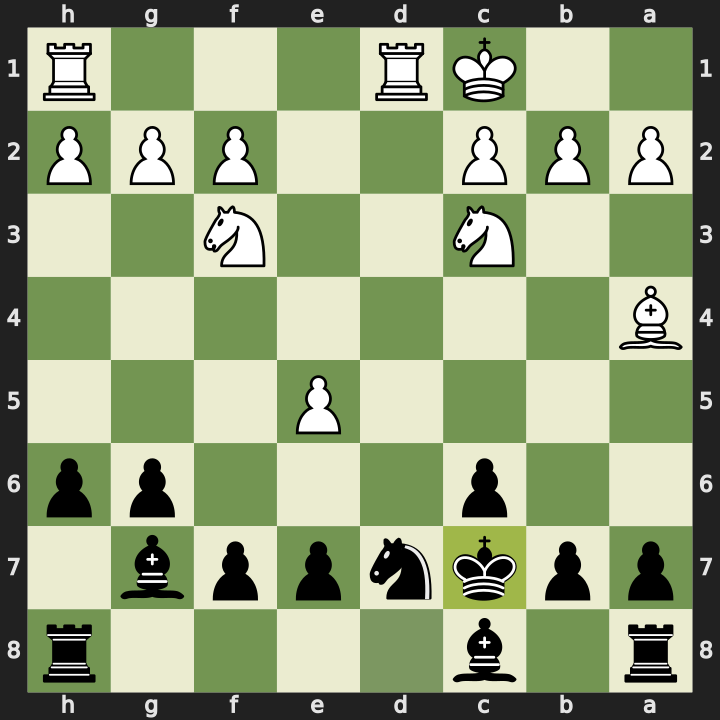
Even though White was able to castle queenside with check, that gave me a chance to develop my knight and then slowly try to get my pieces out of the somewhat cramped position on the queenside. The plan is to do a manual castle type manoeuvre: bring the king to c7, get the bishop out, and get the rooks connected. White attacks the pinned knight on d7 with the bishop and I kick it away with a pawn.
Consolidating (Moves 13-19)
13. Rhe1 e6 14. g3 Nb6 15. Bb3 Nd5 16. Nxd5+ cxd5
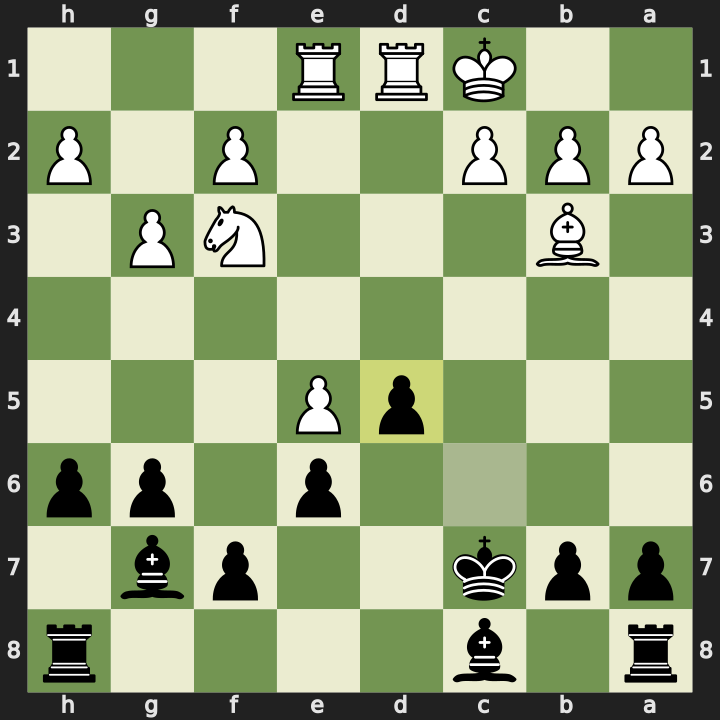
I continued to chase away White’s bishop with my knight and then eventually traded knights on d5, which gives me a nice pawn chain in the centre. White’s bishop has very little activity.
17. Nd4 Bd7 18. Re3 Rac8 19. Rc3+ Kb8
On move 19 I was finally able to get my king into a safer position on b8 with my rook on c8. The rooks are connected, I have two bishops, and otherwise the material is equal. White has a nice pawn chain from h2 to e5 and I’m going to need to use a pawn break to get through it.
The Pawn Break (Moves 20-27)
20. f4 f5 21. Rxc8+ Rxc8 22. c3 g5
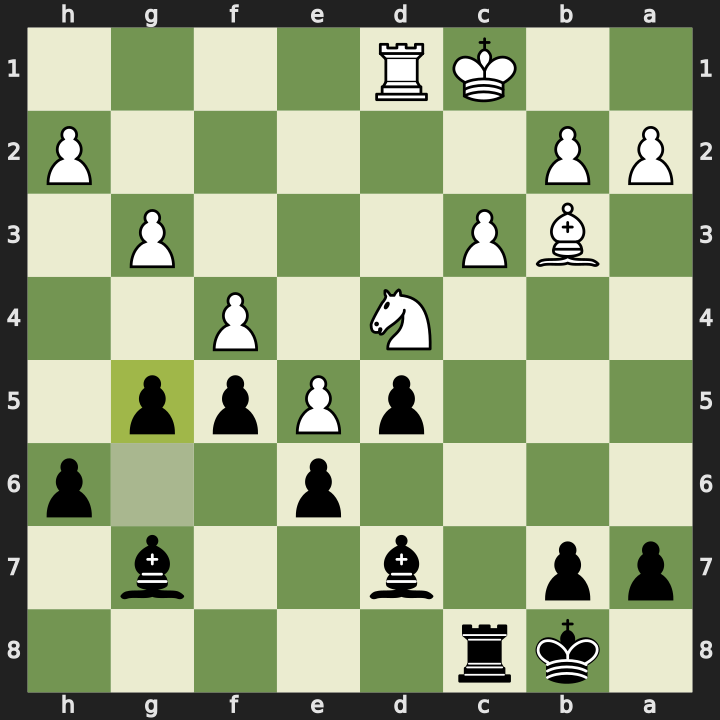
White goes for a rook trade on c8. I think it’s fine because it gives me control of the file. I go for the pawn break with g5, seeing an opportunity to attack the base of the chain. If I can get my bishop to h6 in the future I can pressure f4.
23. h3 gxf4 24. gxf4 h5 25. Rg1 Bh6 26. Ne2 Bb5 27. Nd4 Bxf4+
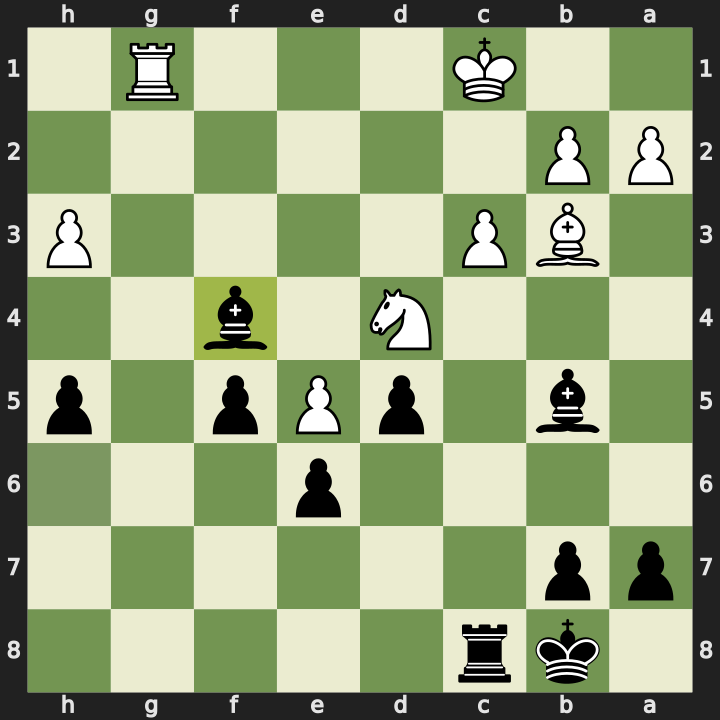
White sees my plan and moves the knight back to e2 to guard the now vulnerable f4 pawn, but I can pressure it with Bb5. White retreats the knight. They can’t block on c4 because I have three pieces attacking that square. This lets me take on f4 and I’m finally up a pawn. As a bonus it comes with check so I get an extra move. At this point I felt like I had a chance at winning the game but it was only a tiny advantage.
The Pin (Moves 28-37)
28. Kc2 Bc4 29. Nxe6 Bxe5 30. Bxc4 dxc4
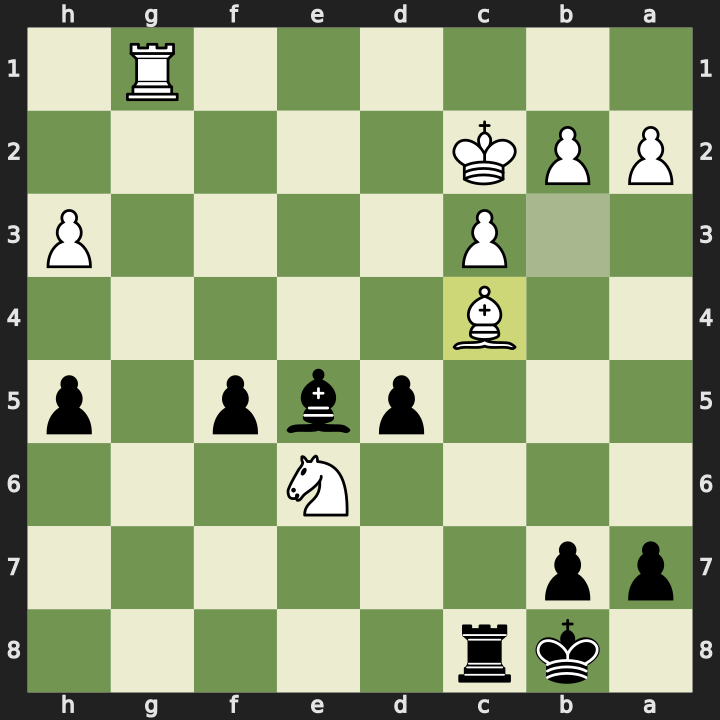
I think I made an error playing Bc4. The idea was to keep tension between the bishops on c4 and b3, but I didn’t properly calculate what would happen after Nxe6. I took a pawn on e5 but now I have three isolated pawns on d5, f5 and h5 and White could bring their rook down to attack them. White exchanged the bishops which allowed me to get my isolated d-pawn over to the c-file, which might let it connect up with the a and b pawns in the future.
31. Re1 Bg3 32. Rg1 f4 33. Rf1 Re8 34. Nxf4 Rf8
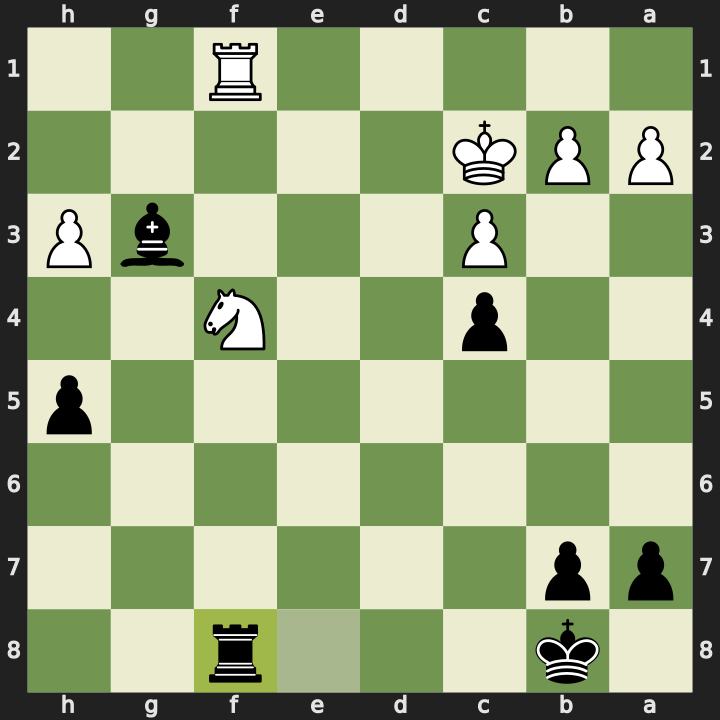
White played Re1 which I think is an inaccuracy. I moved the bishop to g3, then cemented it with an f4 pawn push. White wasted a move by bringing their rook back to g1 allowing me to improve my position for free. White attacked my pawn on f4 and I counter-attacked White’s knight on e6. This is inviting a trade which leaves me down a pawn if I just play Bxf4, Nxf4, Rxf4. But I found a tactic: after Nxf4, don’t retake immediately with the bishop. Instead play Rf8, pinning the knight to the rook. The threat is to take the knight next move with the bishop. If the knight takes the pawn on h5 then I can win White’s rook. White would take my bishop on g3 and I could take the h3 pawn through the knight. I’d be up the exchange in an endgame where we have a king and three pawns each.
35. Nxh5 Rxf1 36. Nxg3 Rf3 37. Ne4 Rxh3
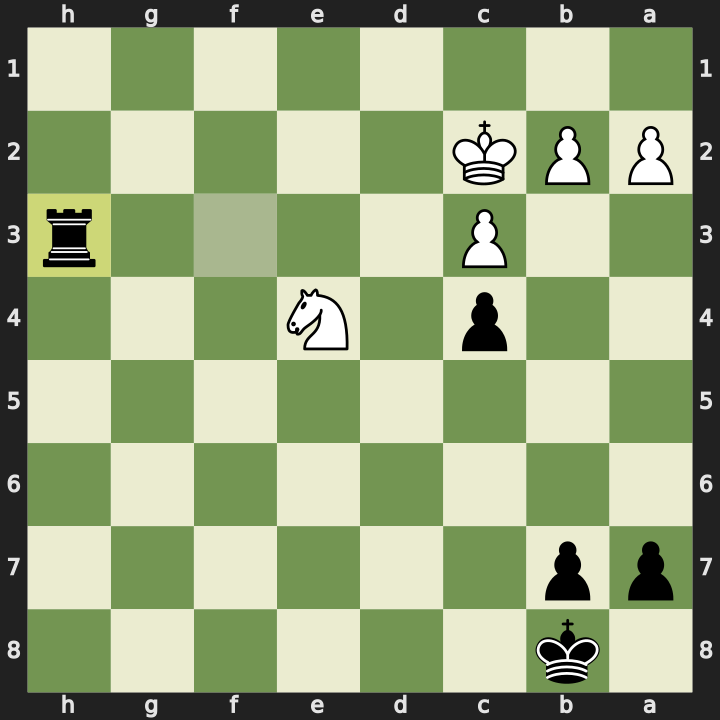
That’s exactly how it played out. After the dust settled I’m up the exchange with a rook versus knight, and three pawns each.
King Activation (Moves 38-46)
38. Nd6 Rh4 39. b3 cxb3+ 40. Kxb3 Kc7 41. Nf5 Rh1 42. Nd4 Kb6 43. Kb4 Ra1 44. a4 Rb1+ 45. Nb3 Kc6 46. c4 b6
White pushes the b-pawn and now my pawn on c4 is double attacked. I decided to trade my c-pawn for White’s b-pawn and then come up with a plan that doesn’t just involve trading all the pieces and ending in a draw.
I realised what I need to do is activate my king, get it out in front of my pawns, and then get the rook around behind White’s king and pawns using a backstabbing strategy. If I can check the king from behind on the b-file that will force it to one side or the other, leaving one of the pawns vulnerable.
When I gave the check on b1, White didn’t move the king to the side. Rather they blocked the check with the knight, which I wasn’t expecting. It kind of makes sense because it allows the king to protect both pawns. I decided to go after the c-pawn, moving my king over to the c-file and then squeezing the White king by advancing my pawns, keeping the knight on b3 pinned.
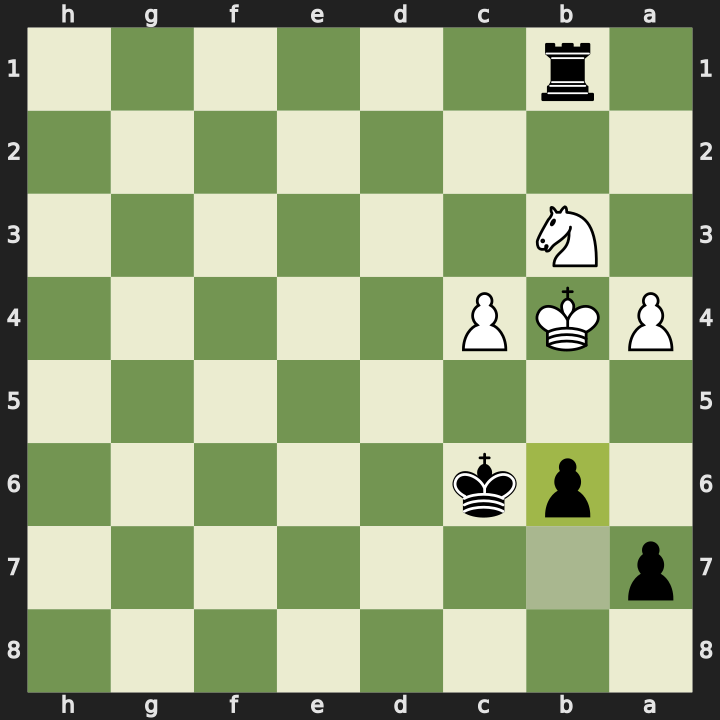
On move 46 White resigned. This came as a surprise to me because I didn’t have a clear path to victory in my mind even though it did feel like I had winning chances. I suppose they weren’t able to see any lines that didn’t lead to losing a pawn or material.
Engine Review
84.0% accuracy for me versus 80.7% for my opponent. Game rating of 1650 for me versus 1500 for my opponent. No blunders and no mistakes for me, but five inaccuracies and three misses. One blunder and four mistakes for my opponent.
As I suspected, Bxf6 isn’t great for White. It gives up a really important piece for a knight. The engine says taking back on e5 with my bishop was an inaccuracy and it would have been better to retreat my bishop immediately rather than inviting more trades in the centre. I was concerned about what would happen if White takes d6, but it’s not a big deal. I can recapture with the c-pawn and there’s no queen exchange. So that’s something I’ll learn from this: I don’t have to take on e5.
Going for the knight trade on moves 14, 15 and 16 was inaccurate. It left the position as equal whereas prior to that I had a slight advantage. The engine likes throwing the pawns forward to attack the bishop, using the pieces that are already concentrated over on the queenside. That might be a bit advanced for me. It’s always a bit unsafe to go for a pawn storm using the pawns in front of the king when there’s an open centre.
f4 was a mistake by my opponent. It looks like a very logical move creating a nice connected pawn chain. The engine prefers Re3, allowing White to access that side of the board without closing it off to the rooks, which would be stuck on the other side of the pawn chain. Interesting.
The engine suggests I should have been the one to initiate the rook trade because White’s only reply is to take back with the pawn, giving them doubled pawns on the c-file. After this trade, the position is completely equal so I gave up a slight advantage by letting White take that trade.
Apparently breaking up the pawn chain with gxf4 was an inaccuracy. Rather than chipping away at the pawn chain on the kingside, the engine prefers to keep the tension there and move the bishop over to the queenside to really concentrate my pieces over there.
White playing Nd4 was a blunder, and my response was correct. Taking the pawn on f4 with check allows me to ignore the threat on my bishop on b5 because I have time to move it.
I missed a very obvious tactic here: Be3, double attacking the rook on g1 and the knight on d4. That move would have eliminated one of White’s well-placed pieces and given me a much stronger position.
White’s next mistake was Nxf4. It’s a perfectly fine move if I do the obvious thing of taking back the knight with the bishop, in which case the position is equal and heading for a draw. But by pinning the knight, Black gets a 3.4 advantage.
White’s final mistake was pushing c4, where with correct play Black is able to separate the king from one of the pawns. Then Black gets a passed pawn on the c-file protected by the king and White isn’t able to defend against both the c-pawn and the a-pawn. It’s mate in 16 moves once White loses their c-pawn, so I’m glad my opponent resigned and didn’t draw the game out for another several weeks.
Reflections
What went well:
- Not fumbling the opening. Retreating the dark-squared bishop back to its home on g7 at the right time was the correct call.
- Spotting the pin of the knight to the rook on move 34. Being up the exchange in the endgame made me feel like I had a chance at winning.
- Activating the king at the end rather than just pushing the pawns forward where they would have been intercepted or taken. Using some endgame technique to get into a winning position.
What to work on:
- Tactical awareness. Missing the Be3 double attack on the rook and knight would have made it a much more convincing victory.
- Deciding which side of the board to play on. Concentrate my pieces in front of the king and go on the attack, or play on the opposite side to where the king is and go for a material advantage. The engine’s feedback is to try and play both sides simultaneously in this kind of position.
Tournament Update
As a result of this game I’m now equal second place in my group for the ForEverOne 2026 tournament. The top three players advance each round, so I’m likely to progress to the next round.
Full PGN:
1. e4 d6 2. d4 Nf6 3. Nc3 g6 4. Nf3 Bg7 5. Bg5 h6 6. Bxf6 Bxf6 7. e5 dxe5 8.
dxe5 Bg7 9. Qxd8+ Kxd8 10. O-O-O+ Nd7 11. Bb5 c6 12. Ba4 Kc7 13. Rhe1 e6 14. g3
Nb6 15. Bb3 Nd5 16. Nxd5+ cxd5 17. Nd4 Bd7 18. Re3 Rac8 19. Rc3+ Kb8 20. f4 f5
21. Rxc8+ Rxc8 22. c3 g5 23. h3 gxf4 24. gxf4 h5 25. Rg1 Bh6 26. Ne2 Bb5 27. Nd4
Bxf4+ 28. Kc2 Bc4 29. Nxe6 Bxe5 30. Bxc4 dxc4 31. Re1 Bg3 32. Rg1 f4 33. Rf1 Re8
34. Nxf4 Rf8 35. Nxh5 Rxf1 36. Nxg3 Rf3 37. Ne4 Rxh3 38. Nd6 Rh4 39. b3 cxb3+
40. Kxb3 Kc7 41. Nf5 Rh1 42. Nd4 Kb6 43. Kb4 Ra1 44. a4 Rb1+ 45. Nb3 Kc6 46. c4
b6 0-1