Rapid Session 1: Shaking off the Rust
| Time Control: 10 min Rapid | Games: 3 (Unrated) | Record: 2W / 1L |
Overview
It’s been a very busy and stressful couple of weeks, so I’ve been exclusively playing correspondence games and bot matches. I have a coaching lesson coming up this week and I wouldn’t be able to look my coach in the eye if I hadn’t played at least a few live games, so to get back into the swing of it I played three unrated rapid games this morning.
I’ve noticed that I suffer from nervousness in live games, and I suspect it’s because I have an irrational attachment to my rating points, which aren’t even very high. I don’t like losing them. So just to get my confidence back, I decided to play some unrated games. I won 2 out of 3, and there was some good tactical awareness in the two wins. The first one I can write off as a warmup.
All Games
| # | Color | Opponent | Result | Moves | |
|---|---|---|---|---|---|
| 1 | ⚔️ | White | JoaoV_Amorim (706) | Loss (checkmate) | 28 |
| 2 | 🏳️ | White | sam23in (720) | Win (resignation) | 30 |
| 3 | 🏳️ | White | SharpVinegar (755) | Win (resignation) | 18 |
Game 1: The Warmup (Loss vs JoaoV_Amorim, 706)
We got into a good position out of the opening and I was very happy with how things were going. Then on move 16 my opponent attacked my queen with their knight via 16…Nc3. The best move would have been 17. Qf3, putting the queen in a strong position to attack the castled king in a couple of moves time. But I thought, “what the heck, this is an unrated game, let’s try something aggressive,” and went with the bishop sacrifice 17. Bxh7+.
My opponent tried to counter-attack the bishop and queen checks by playing 20…Ne2+, but it just blundered their knight, so I took with the queen and continued. Black exchanged a bishop for the knight on g6, and my plan was to continue attacking with rooks and queen.
Then Black played 23…Qxa3 attacking my rook, and I was too tunnel-visioned on my own attack. I moved the f-file rook with 24. Rf3, which was the only defender of the c-file rook. Black takes with check, and a few moves later I get checkmated.
This was exactly the warmup I needed. It reminded me to slow down, look at the opponent’s threats, understand what they’re trying to do, and then make my own move. The next two games things got better.
Highlight: Win vs sam23in (720) as White
My opponent opened with an Englund Gambit. I’m not familiar with this opening at all, but my rough policy with these kinds of pawn gambits is to accept a single pawn but not more than that, and that’s what I did here. I took the pawn in front of the king and then focused on my own development.
1. d4 e5 2. dxe5 d6 3. Nc3 Nc6 4. Nf3 dxe5 5. Qxd8+ Kxd8 6. Be3 Bd7 7. O-O-O
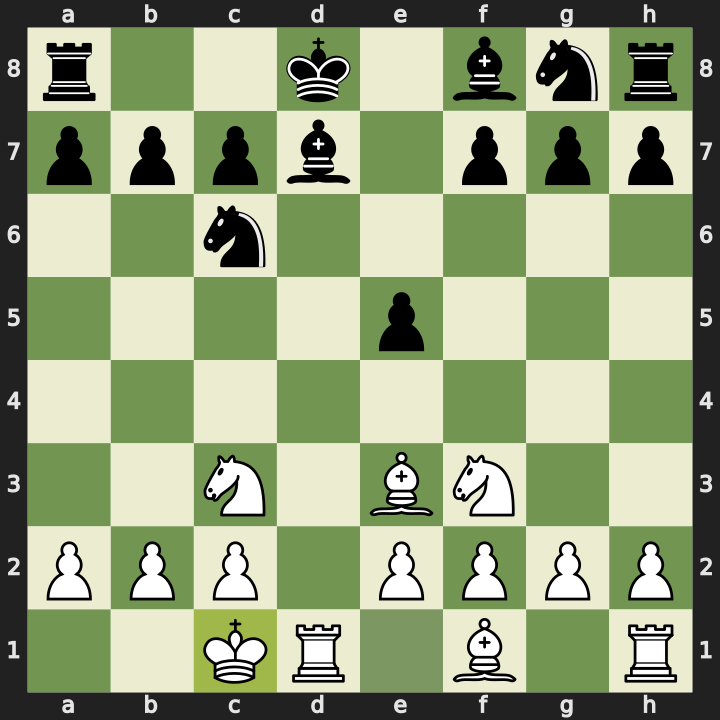
On move 5 I saw an opportunity to do an early queen exchange with Qxd8+. Black would have to choose between either moving their king and losing the right to castle, or losing tempo by taking with their knight and sending it back to the 8th rank. Black elected to take with the king, which is great: that means I’ve gained an advantage without giving up any material.
Next I saw an opportunity to castle queenside, putting my rook in line with the Black king and pinning the bishop they’d parked on d7. Black would need to address this pin somehow.
7…Bd6 8. g3 Nf6 9. Bg2 Ke8 10. Nb5 Ne4 11. Rxd6 Nxd6 12. Nxc7+
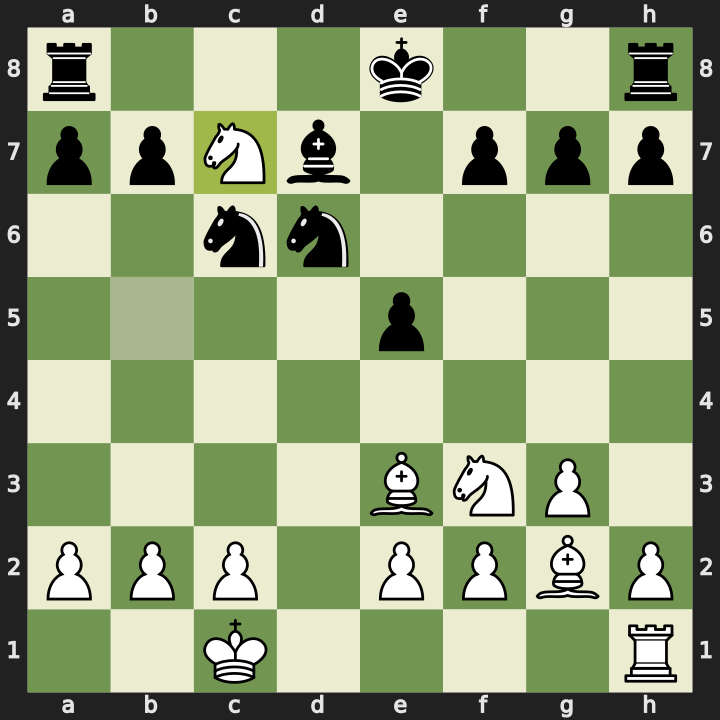
Black moved the king back over to the e-file, and this is where I saw a nice tactical opportunity. I temporarily sacrificed the exchange with 11. Rxd6, then won it back by forking the king and rook with 12. Nxc7+. After the trades, I’ve won a pawn.
12…Ke7 13. Nxa8 Rxa8 14. Rd1 e4 15. Nd4 Bg4 16. f3 Nxd4 17. Bxd4 exf3 18. exf3 Bf5 19. g4 Bg6 20. f4 Be4 21. Bxe4 Nxe4 22. Re1
By move 20 I noticed I almost had the Black bishop trapped on g6. Black could have pushed the f-pawn to make room for the bishop to retreat, but that would have been an awkward square for it and they would have lost time manoeuvring it back into a good position. Instead they decided to trade it in front of the king with 20…Be4.
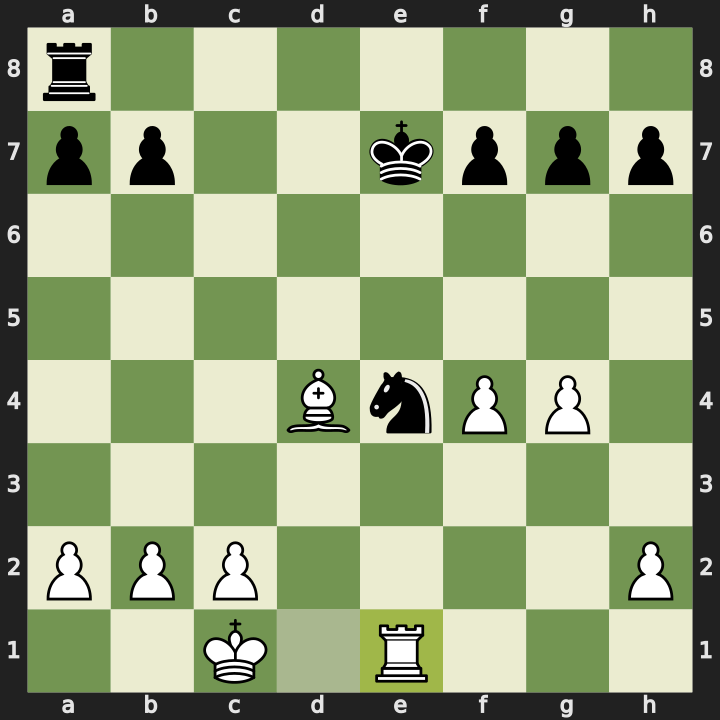
I’d seen that this trade would leave the recapturing knight pinned by my rook to the king on e7. With 22. Re1 the pin is set. There’s no good way for Black to defend the knight while keeping the king on e7.
22…f5 23. gxf5 Kd7 24. Rxe4 Rf8 25. Re5 a6 26. b4 Rc8 27. Kb2 Rc4
Black tried f5 to break the contact, but after 23. gxf5 the knight is still pinned. Black had to move the king with 23…Kd7 to free it, and that let me play 24. Rxe4 and win the knight. I was really happy to see that tactical opportunity.
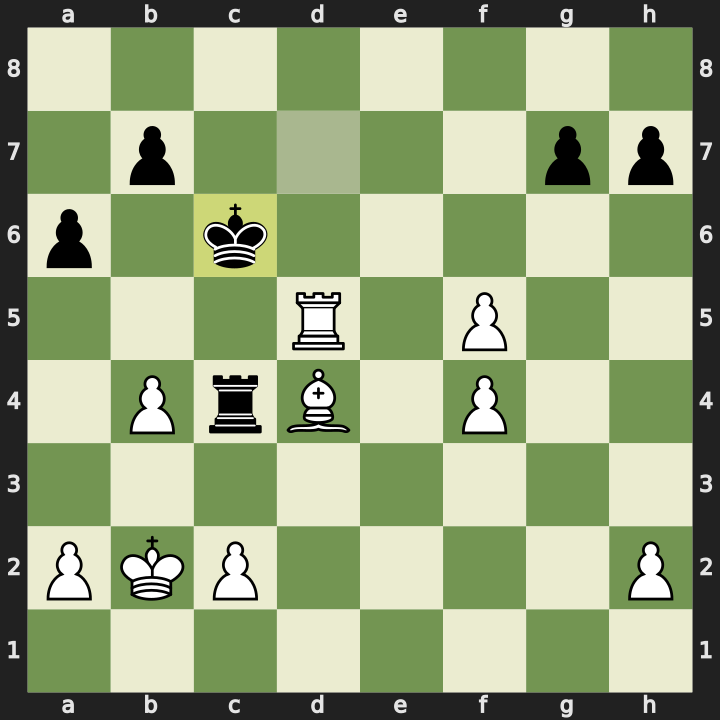
On move 27 Black played Rc4, what looks like a strong move double-attacking a pawn and the bishop on d4. But I was able to check the king with 28. Rd5+, and Black made a mistake by walking the king to Kc6, putting it on the same file as their rook. 29. Rc5+ would force a rook trade that leaves me up a piece. Black then blundered again: rather than trading rooks, they simply retreated the king with Kd7, allowing me to take the rook for free. Black resigned.
I really enjoyed this game. I think the early queen trade was the right call, and then it was just playing considered, careful moves and waiting for the tactical opportunities to present themselves.
Highlight: Win vs SharpVinegar (755) as White
This was more of a loss by my opponent than a win for me, but it’s still a nice reminder that opponents will make mistakes too. The thing I was very happy with in this game was being comfortable parking my bishop on b2 and using it to take a pawn and later a knight, then retreating it back to b2 where it could quietly sit and wait for its next opportunity to snipe a piece. That’s exactly what led to Black blundering their queen.
1. d4 d5 2. Nf3 Nf6 3. b3 e6 4. Bb2 Be7 5. e3 O-O 6. Bd3 c5 7. Nbd2 cxd4 8. Bxd4 Nc6 9. Bb2 b6 10. O-O Bb7 11. Ne5 Nxe5 12. Bxe5 Bd6 13. Bb2
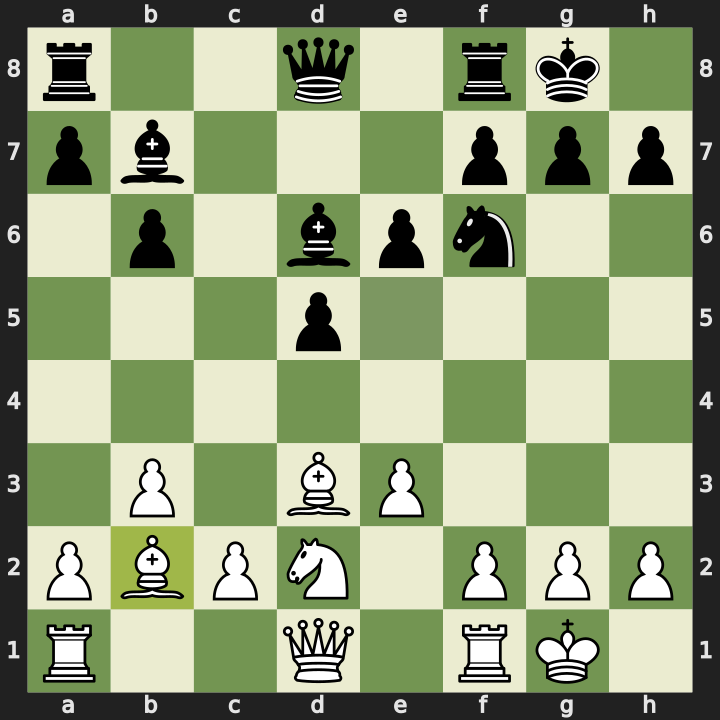
The bishop on b2 had already grabbed a pawn on d4 and a knight on e5, and now it’s back on its starting fianchetto square. It looks like nothing much, but it’s quietly aiming down the long diagonal at f6 and beyond.
13…e5 14. f4 e4 15. Be2 a6 16. Bh5 Nxh5 17. Qxh5 Qf6
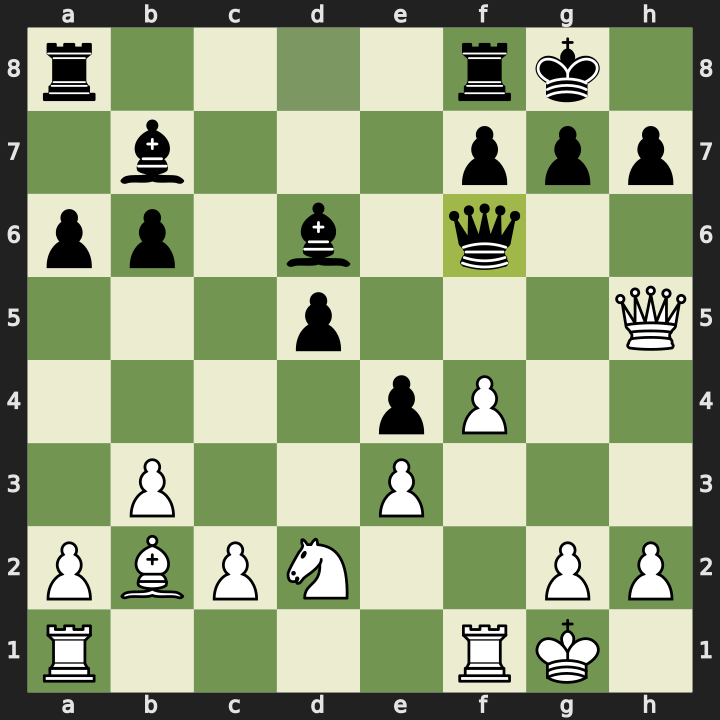
On move 16 I wanted to get rid of the knight on f6 and didn’t see a good way to do it other than putting my bishop on h5 as bait. Black could take it and then I could recapture with my queen, placing it near the Black king and perhaps forcing an attack using the rook and queen later. Black complied, taking the bishop, and after I retook with my queen they tried to solidify their defence with Qf6.
But I had my bishop back on b2 ready to strike for a third time. 18. Bxf6 took the queen and Black immediately resigned. I’m really happy that my plan to dislodge the knight worked out, and this time it was my opponent not considering the long-range pieces and blundering, not me.
Reflections
Overall a really positive three-game session to get back into playing live chess in the mornings. I plan to keep doing this, and next time I’ll play rated games to see if I can earn some points. It’s amazing how, when I play unrated games, it’s just for fun and there isn’t much pressure.
Tomorrow a new tournament starts, and over the next few days I’ll have round 2 of previous tournaments beginning as well, so my daily correspondence games workload is about to go up. But those games can be my evening activity where I don’t need 100% concentration for 20 minutes straight. I just need to make one move at a time and can use the analysis board to explore different positions.
What went well:
- Spotting tactical opportunities in Games 2 and 3: the Nxc7+ fork, the pin on the e-file knight, the king-and-rook setup for Rc5+, and the b2 bishop sniping the queen.
- Being patient in Game 2. After the early queen trade I just kept making considered moves and let the opportunities come.
What to work on:
- Looking at opponent threats before making my own move. Game 1 was a textbook case of tunnel vision: I moved the only defender of my c-file rook because I was so focused on the kingside attack.
- Not confusing “unrated” with “careless”. Unrated games are a great opportunity to take risks and practice calculating attacking lines like the Bxh7+ sacrifice. That’s a good thing to do. What I need to avoid is the bot-match mindset where I stop checking opponent threats because the game doesn’t feel like it counts.