Win vs GudoFF (1326)
| Opening: Englund Gambit, declined (A40) | Result: 1-0 (Resignation) | Time Control: 3 days/move (Daily) | Rated | Event: 92nd Chess.com Daily Tournament (1201-1400), Round 1 |
Game Overview
This was a game of ups and downs. After thinking I’d come up with a clever trap in the opening, I ended up taking my knight on a tour around the board before finally spotting a brilliant move that led to resignation, with my opponent forced to either give up the queen or get checkmated.
Declining the Gambit (Moves 1-4)
1. d4 e5 2. Nf3 e4 3. Ne5 f6 4. e3
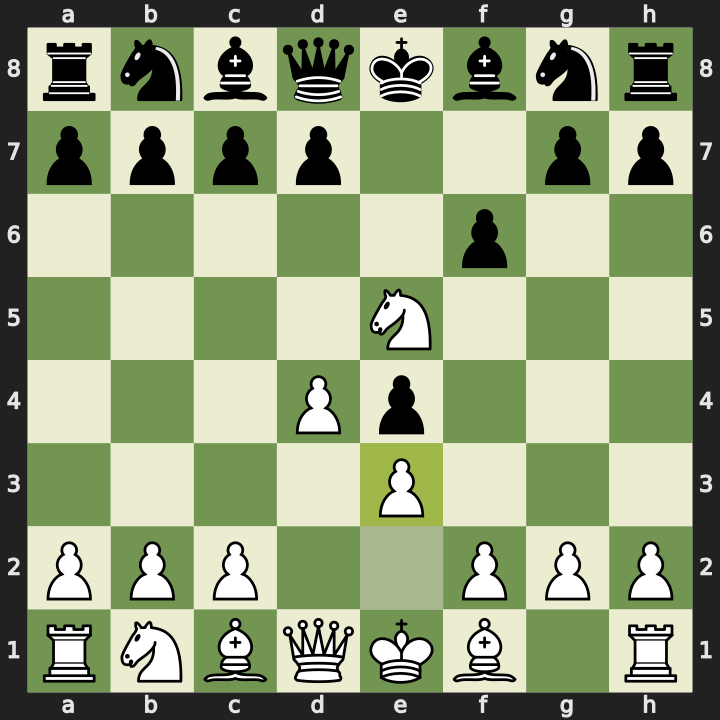
The game started with an Englund Gambit. I really wanted to play something more like my standard d4 opening, so I declined the gambit with 2. Nf3. Black advanced with 2…e4 to attack my knight, and I came up with an interesting plan: jump into e5, and when Black kicks the knight with 3…f6, don’t retreat it, play 4. e3 instead. If Black grabs the knight with 4…fxe5, then 5. Qh5+ g6 6. Qxe5+ forks the king and the rook on h8, and once the king moves the queen scoops the rook.
My opponent didn’t take the bait. I guess daily games aren’t really the format where people fall for traps like that.
The position after 4. e3 has one of the great absurd names in the opening database. Chess.com files it as the Englund Gambit Declined: Reversed Alekhine, Reversed Krebs, Reversed Mokele Mbembe Variation. I have no idea how one quiet little pawn move earns three “reversed” labels stacked on top of each other. The Mokele-mbembe is a long-necked river monster from Congo folklore, the name roughly meaning “one who stops the flow of rivers,” so at least my knight had a properly mythical title to live up to while it wandered around the board.
The Knight’s Grand Tour (Moves 4-12)
4…g6 5. Nc4 d5 6. Ncd2 Nc6 7. Nc3 Be6 8. Be2 Bd6 9. f3 f5 10. O-O f4
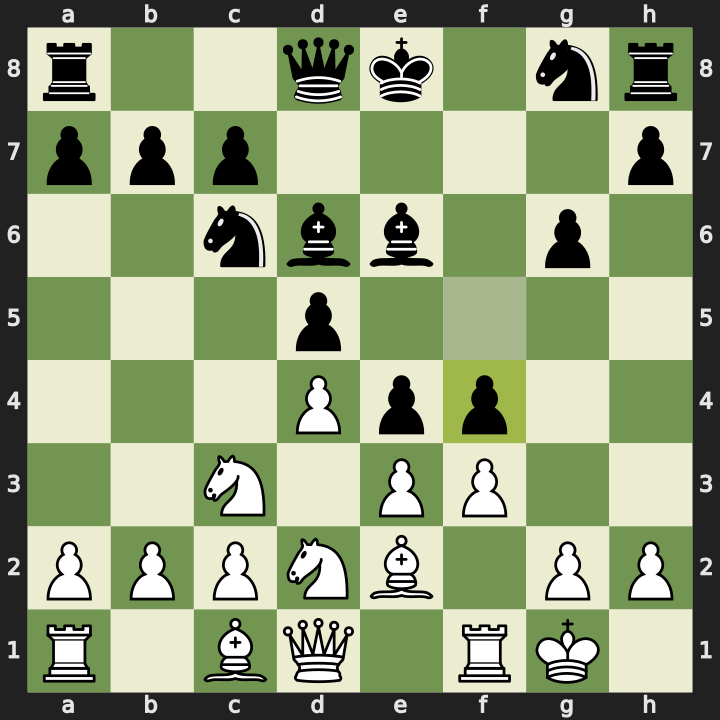
With the trap declined, my knight on e5 had nowhere useful to go, so I spent the next few moves shuffling it around: out to c4, back to d2, and developing the rest of my pieces behind it. The pawns ended up tangled on the e and f files.
11. fxe4 fxe3 12. Nf3
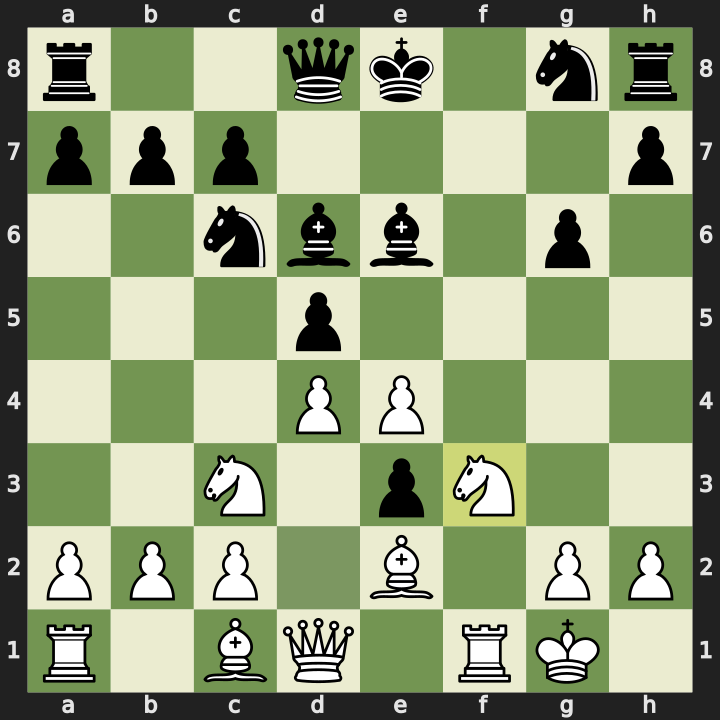
By move 12 the knight had finally returned home to f3, exactly where it started on move 2. Hilarious.
Finding a Plan (Moves 12-16)
12…Bf4 13. g3 Bh6 14. exd5 Bxd5 15. Nxd5 Qxd5
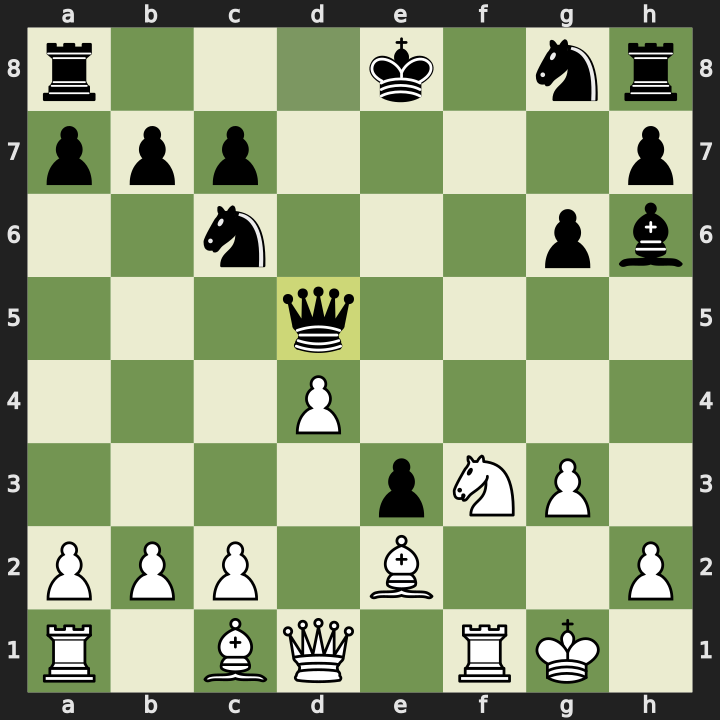
By move 15 things were looking fairly equal. Black had a nicely centralised queen but still hadn’t castled. Black’s own pawn stuck on e3 was actually doing me a favour, sitting in the way of Black’s dark-squared bishop and keeping it from infiltrating.
16. c4
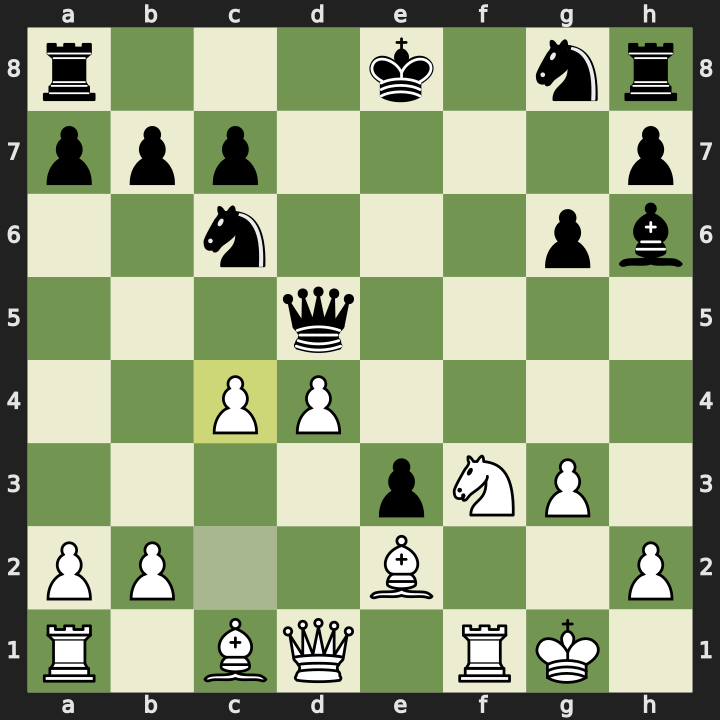
It took me a while, but I eventually saw how strong 16. c4 would be here, hitting the queen.
Building the Attack (Moves 16-18)
16…Qd7 17. d5
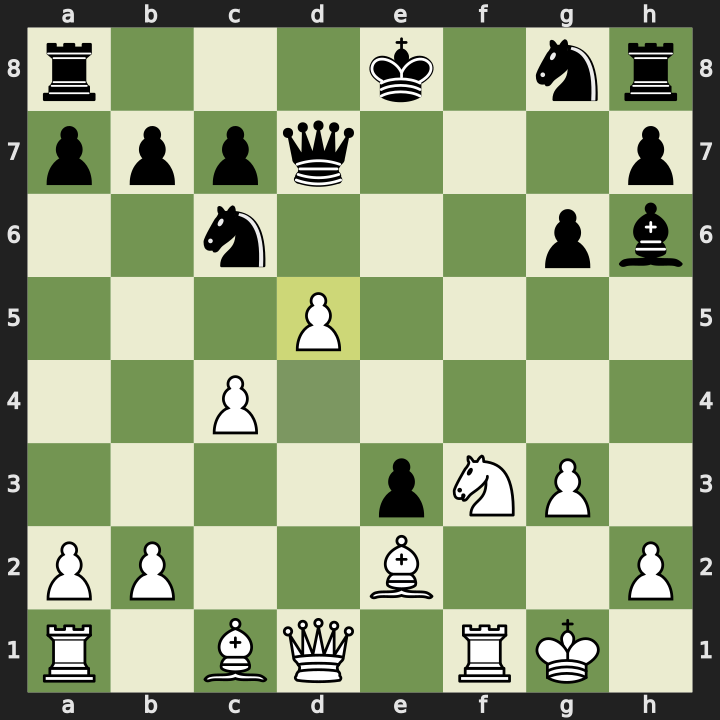
Black retreated the queen, so I pushed the d-pawn, this time hitting the knight on c6.
17…Nce7 18. Qd4
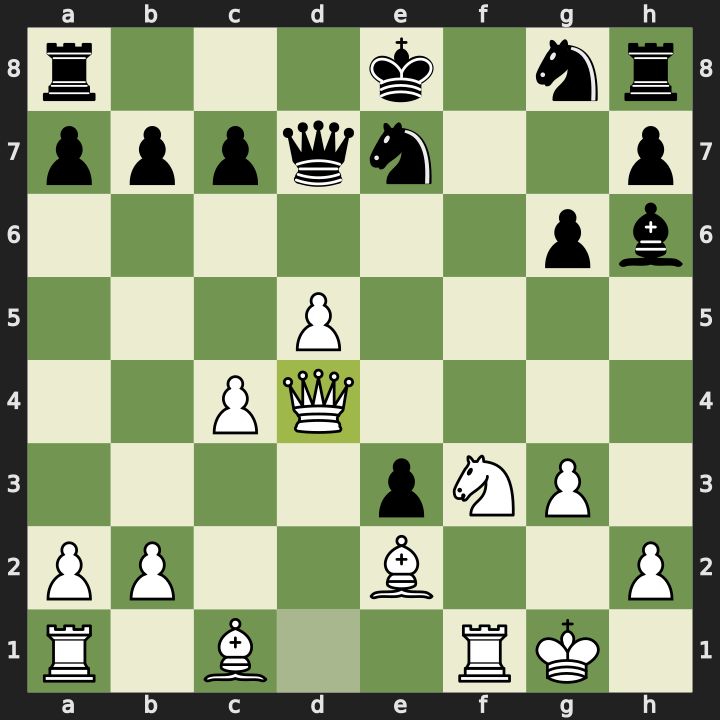
The knight retreated and I got my queen onto the beautiful d4 square, aimed right at Black’s undefended rook, which had stayed on h8.
The Blunder and the Finish (Moves 18-20)
18…O-O-O
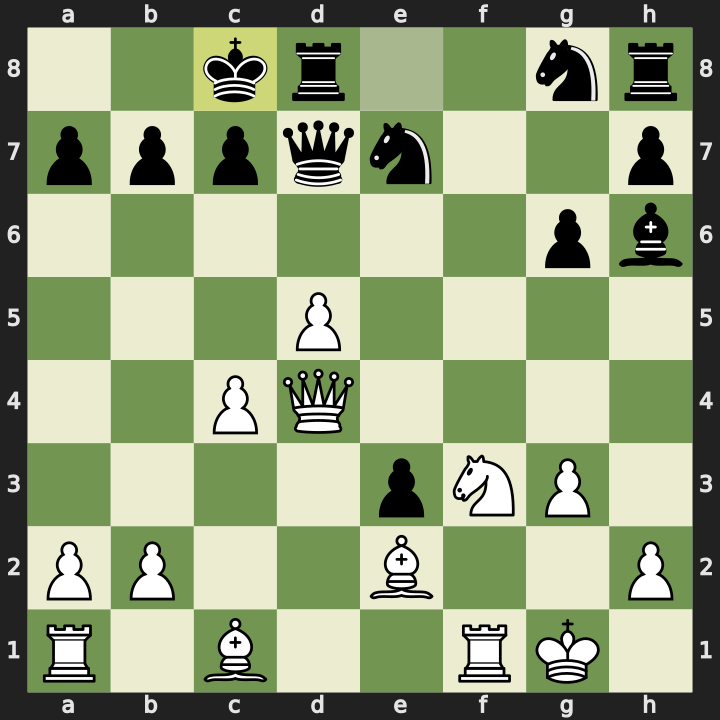
Here Black made the mistake. Castling queenside, presumably to bring the other rook into the game and form a battery with the queen on the d-file. It looks like it could be powerful, but it overlooked the weakness it created on a7.
19. Ne5
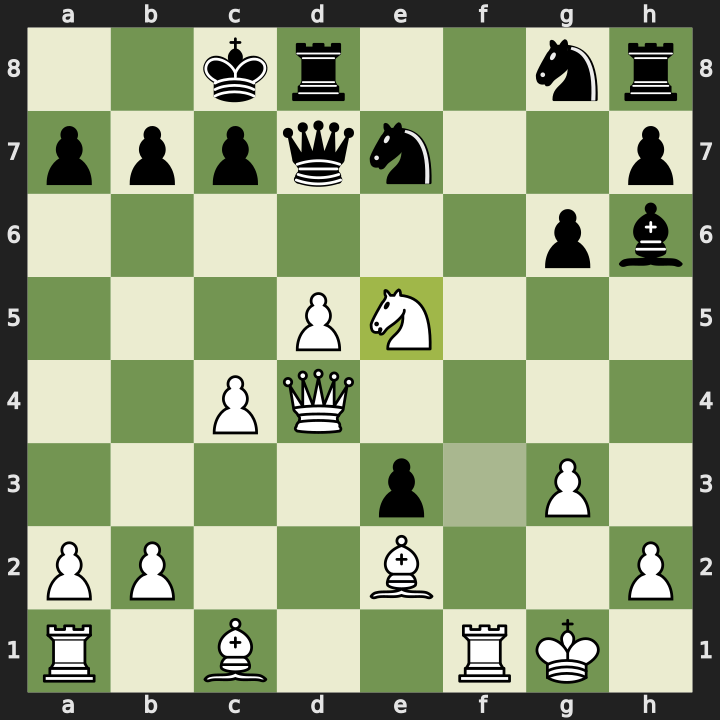
I could see that taking on a7 with the queen was almost a guaranteed checkmate, but Black would have a defence: push the c-pawn or move the queen to give the king an escape square. So first my trusty knight, the one that had already toured the board once, went back to e5. A much more principled move this time, attacking the queen and, just as importantly, covering the d7 escape square.
19…Bg7 20. Qxa7
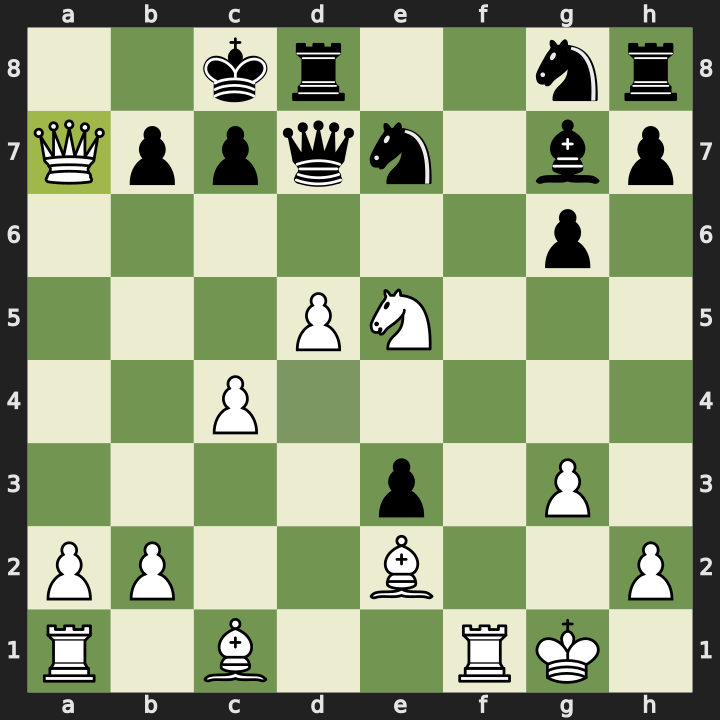
Black didn’t see through the plan and played 19…Bg7, hoping to pin my knight to my queen. But once Black had castled, my queen’s eyes were firmly on a7, so I played 20. Qxa7. The brilliant move. From here Black can move the queen and get mated by Qa8, or play c6 and lose the queen to dxc6. Naturally, Black resigned.
Engine Review
79.4% accuracy for me versus 70.3% for my opponent. Game rating of 1500 for me versus 950 for my opponent. One brilliant move and one great move for me, with no blunders on either side. Chess.com flagged the opening as an inaccuracy for both of us and rated my middlegame brilliant.
It wasn’t the most accurate game, partly because of my dubious opening play, but I think the ending redeemed it. The engine doesn’t like 7. Nc3, preferring 7. c4 to challenge the centre. It also dislikes my 9. f3 push and Black’s 9…f5 and 10…f4 replies. By move 10 I was out of danger with about a two-point advantage, recovering from the opening.
Towards the end there were faster ways to convert. The knight could hop into e5 even before the queen advances, and the queen can take on a7 even before the knight attacks it. The move order I used was fine, but the engine finds forcing lines that lead to checkmate rather than just winning the queen. I like the line I played. It caught my opponent off guard and brought home the win. 20. Qxa7 earned chess.com’s brilliant move award.
Reflections
What went well:
- The 16. c4 hit on the queen, which got my pieces rolling forward.
- The big one: finding 20. Qxa7 and preparing it with 19. Ne5, threatening the queen while covering d7. Two strong threats at once, leading straight to a winning position.
What to work on:
- Studying a bit about how to play against the Englund Gambit properly. My knight-sacrifice trap obviously isn’t going to work very often.
- Looking harder for the engine’s faster forcing lines. The line I played won, but there were quicker paths to checkmate at the end.
Full PGN:
1. d4 e5 2. Nf3 e4 3. Ne5 f6 4. e3 g6 5. Nc4 d5 6. Ncd2 Nc6 7. Nc3 Be6 8. Be2
Bd6 9. f3 f5 10. O-O f4 11. fxe4 fxe3 12. Nf3 Bf4 13. g3 Bh6 14. exd5 Bxd5 15.
Nxd5 Qxd5 16. c4 Qd7 17. d5 Nce7 18. Qd4 O-O-O 19. Ne5 Bg7 20. Qxa7 1-0