Loss vs 6hostii (1127)
| Opening: Pirc Defense: Austrian Attack (B09) | Result: 1-0 (Resignation) | Time Control: 3 days/move (Daily) | Rated | Event: WCL 2026 Round 8, Team Australia-Brisbane QLD vs Team Philadelphia, Board 12 |
Game Overview
A classic battle of the Austrian Attack versus the Pirc Defense, this time with the black pieces. The game went okay for a long while. I was down just one pawn and holding things together, right up until move 27. Then I played Rd7 instead of defending the pawns in front of my king, the queen came crashing in, and from there my position crumbled. I lost more pawns and couldn’t stop White from promoting.
The Opening: a Sacrifice to Equalise (Moves 6-10)
1. e4 d6 2. d4 Nf6 3. Nc3 g6 4. f4 Bg7 5. Nf3 O-O 6. Bc4 Nxe4
The Austrian Attack is White’s most aggressive try against the Pirc, with the f4 pawn supporting a big centre. After 6. Bc4 I went for the thematic shot: 6…Nxe4, giving up the knight.
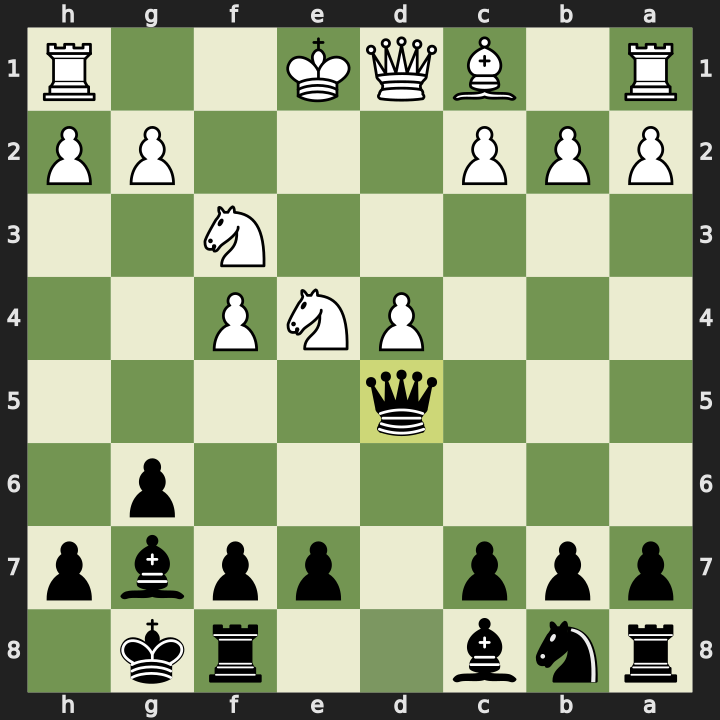
7. Nxe4 d5 8. Bxd5 Qxd5 9. Nc3 Qe6+ 10. Ne2 c6
White recaptured the knight, and then 7…d5 forked the bishop on c4 and the knight on e4. White avoided losing a piece with 8. Bxd5, but after 8…Qxd5 my queen had collected the bishop. Material was level again, and the engine actually had me about +0.9, a near-pawn edge out of the opening. The queen got chased around a little with 9. Nc3 Qe6+ 10. Ne2 c6, but I came out of it comfortably. Chess.com flagged 6…Nxe4 as a brilliant move.
Settling In (Moves 11-18)
11. O-O h6 12. Ng3 f5 13. Ne5 Nd7 14. Bd2 b6 15. Qf3 Nxe5 16. dxe5
We both castled kingside and the middlegame settled into a roughly level fight. White planted a knight on e5, I challenged it with 13…Nd7, and after 15…Nxe5 16. dxe5 White ended up with a pawn wedged on e5. Nothing was wrong with my position yet.
16…Ba6 17. Rfe1 Qc4 18. Bc3 e6
I developed my light-squared bishop to a6, eyeing White’s e2 knight, and brought the queen out to c4.
Losing a Pawn on the Queenside (Moves 19-24)
19. Rad1 b5 20. Ne2 b4 21. Rd4 Qb5 22. Rxb4
I pushed my b-pawn up the board, 19…b5 and 20…b4, but it ran straight into trouble. After 21. Rd4 Qb5 22. Rxb4 White simply rounded the pawn up.
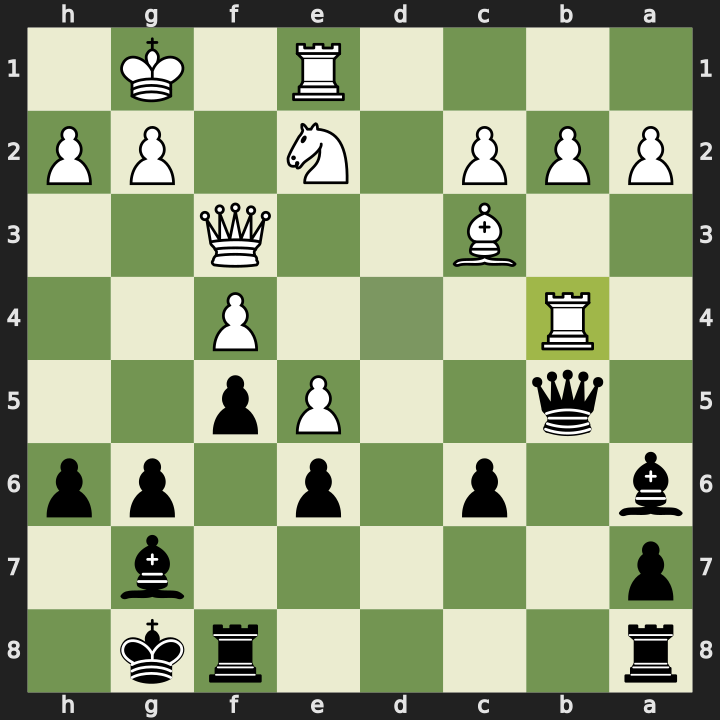
22…Qc5+ 23. Kh1 Bxe2 24. Rxe2 Rfd8
I traded my light-squared bishop off for the knight with 23…Bxe2 24. Rxe2 and brought a rook to the d-file. A pawn down, but the position was still holding together.
The Slip: 27…R8d7 (Moves 25-28)
25. Qg3 Rd1+ 26. Re1 Rad8 27. h3
I doubled my rooks on the d-file, with the front one sitting on d1 and giving check along the back rank. White blocked with 26. Re1 and then played 27. h3 to give his king an escape square on h2.
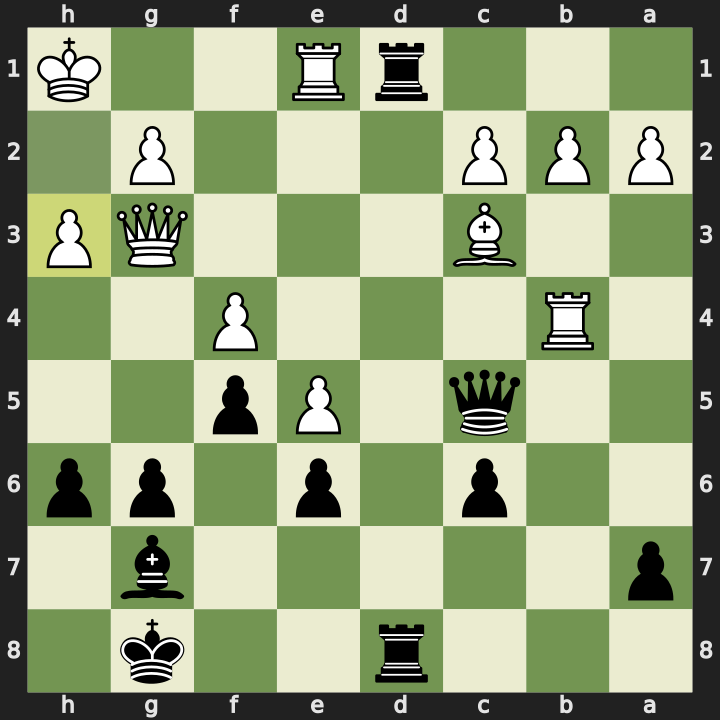
This is where it went wrong. The queen on g3 was bearing straight up the g-file at the g6 pawn, which was the cover in front of my king and already undefended. I needed to deal with that. Instead I played 27…R8d7, moving my back rook off the d-file and doing nothing about the threat.
27…R8d7 28. Qxg6
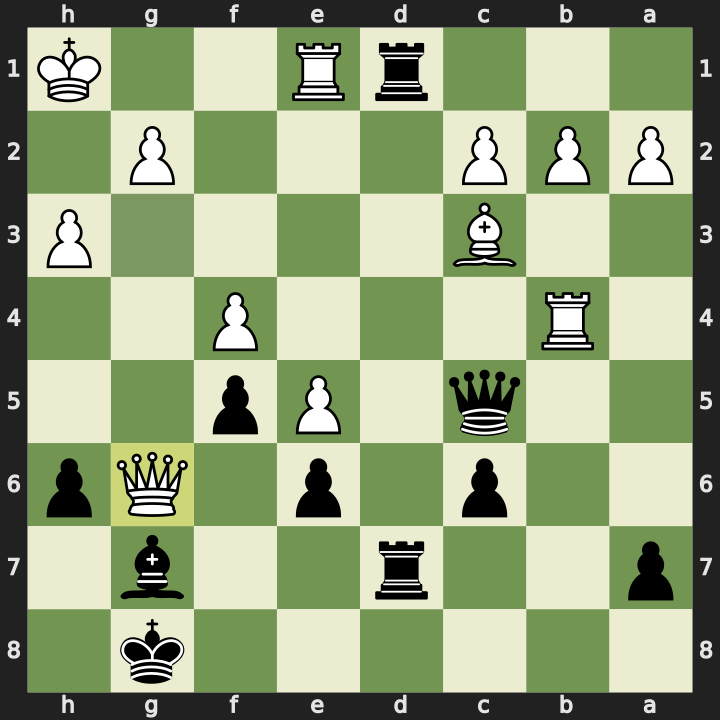
28. Qxg6 took the pawn and ripped open the front of my king. From here things fell apart quickly.
The Collapse (Moves 28-33)
28…Rxe1+ 29. Bxe1 Qe7 30. Rb8+ Rd8 31. Rxd8+ Qxd8 32. Qxe6+
I traded a pair of rooks with 28…Rxe1+ 29. Bxe1, but 30. Rb8+ check forced 30…Rd8, and after 31. Rxd8+ Qxd8 32. Qxe6+ the queen was loose in my position, picking off pawns with check.
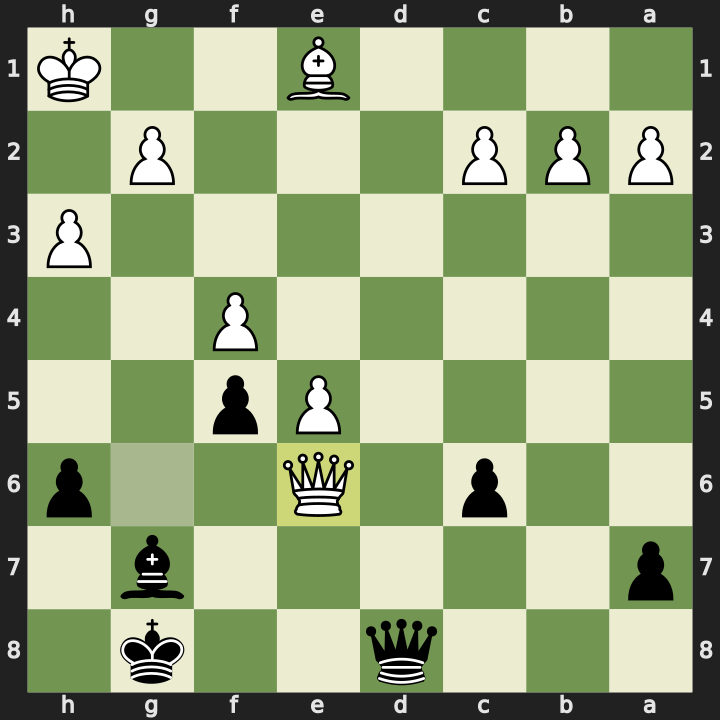
32…Kh7 33. Qxf5+ Kh8
My king shuffled around while the queen kept eating: 33. Qxf5+ took another pawn with check. The pawn shield was gone and I was down several pawns.
The Passed Pawn (Moves 34-43)
34. e6 Qe7 35. b4 Qd6 36. c3 Qd1 37. Qe4 Qh5 38. Qxc6 Qg6 39. Qd7 Qb1 40. e7
Now White’s e-pawn was a passed pawn with a clear run. I shuffled my queen around trying to bother White and pick up something on the back rank, but White kept everything defended and pushed: 34. e6, then all the way to 40. e7.
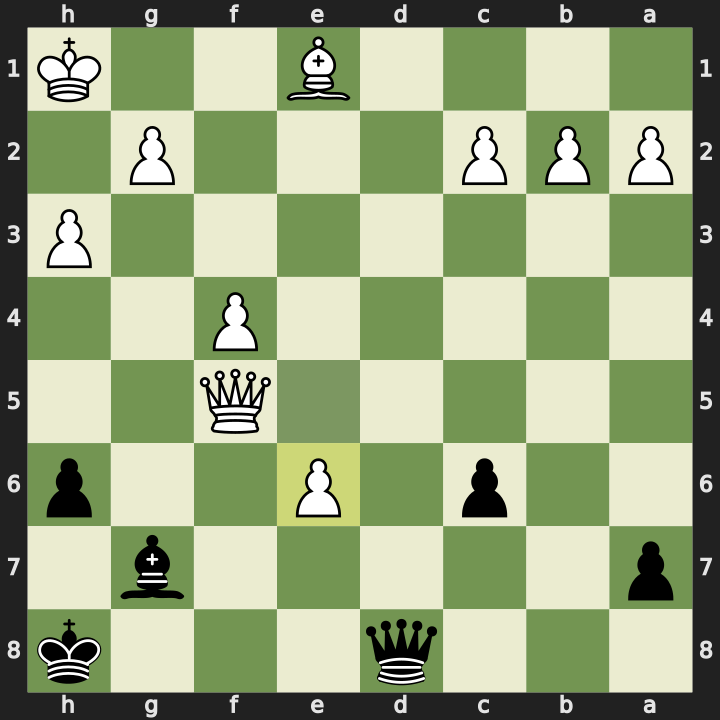
40…Qxe1+ 41. Kh2 Bxc3 42. e8=Q+
I grabbed the bishop on e1 with check and took the c3 pawn with my own bishop, but it was far too little. 42. e8=Q+ brought a new queen on with check.
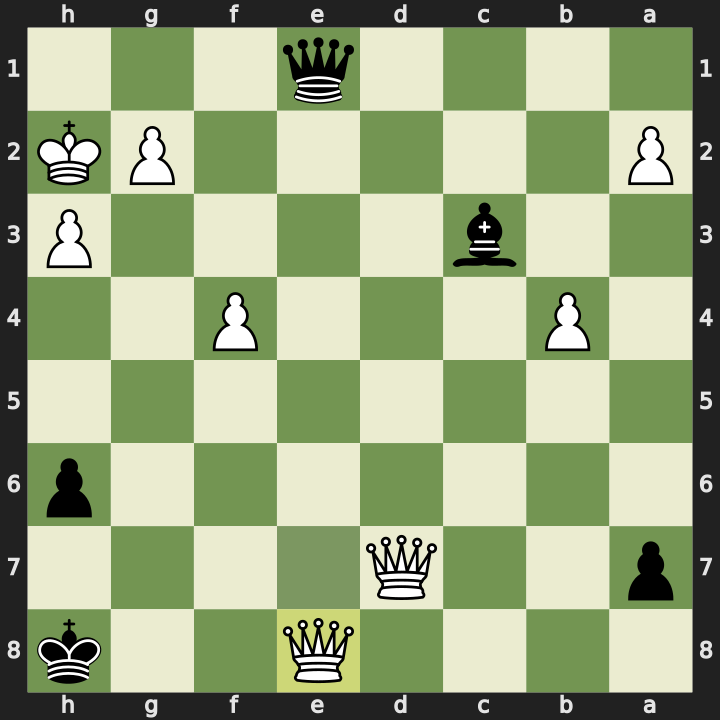
42…Qxe8 43. Qxe8+
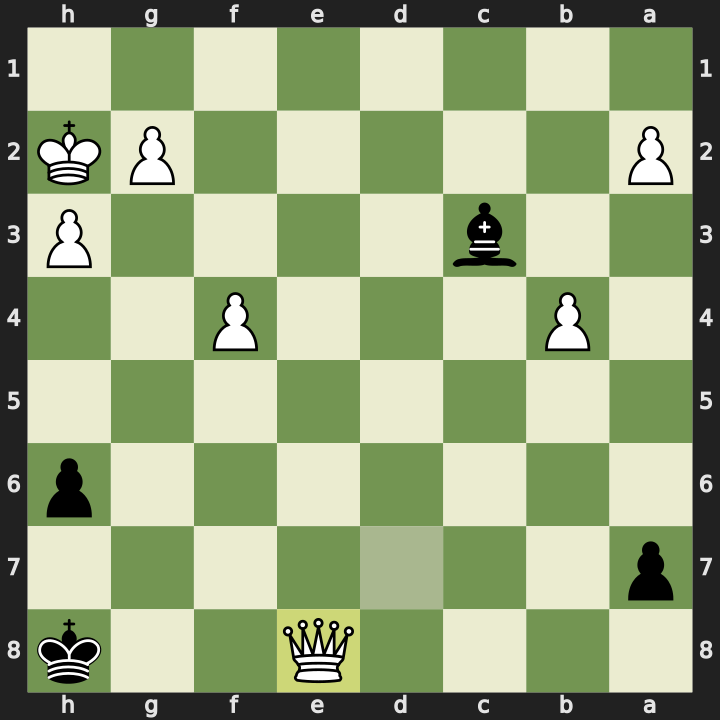
I took the new queen, but it was defended, so 43. Qxe8+ won it straight back and left me a queen down. I resigned.
Engine Review
81.1% accuracy for me against 87.6% for my opponent, with a game rating of 1550 versus 1850. The shape of the report says it all: one brilliant move in the opening (the 6…Nxe4 sacrifice that equalised the material), but only a green check for my middlegame. One brilliant and one great move on my side, but also three inaccuracies, two mistakes, and one blunder.
The blunder is the one that decided the game. Up to move 27 I was only a pawn down and the engine had the position roughly stable. 27…R8d7 was the blunder: it ignored the g6 pawn, which the queen on g3 was already attacking with nothing defending it. After 28. Qxg6 the front of my king was open and White converted cleanly, mopping up pawns with checks and running the e-pawn home to promote.
Reflections
What went well:
- The opening. The 6…Nxe4 sacrifice followed by the 7…d5 fork won the material straight back and got me out of the Austrian Attack with a small edge, the engine had me around +0.9. The engine rated it brilliant, and it’s nice to see a sharp tactical idea pay off against this aggressive line.
- Holding a slightly worse position for a long time. Being a pawn down isn’t fun, but for twenty-odd moves I kept the game together.
What to work on:
- King safety. The whole game turned on one move where I had to defend the pawns in front of my king and didn’t. The g6 pawn was attacked and undefended, and I played a rook move on the other side of the board as if the threat wasn’t there. When the opponent’s queen is pointing straight at my king’s pawn cover, that has to be the first thing I look at.
- Not drifting when slightly worse. I was only a pawn down. A pawn-down position is defensible, but it asks for accurate moves, and one careless move was all it took to turn a hard hold into a loss.
Full PGN:
1. e4 d6 2. d4 Nf6 3. Nc3 g6 4. f4 Bg7 5. Nf3 O-O 6. Bc4 Nxe4 7. Nxe4 d5 8. Bxd5
Qxd5 9. Nc3 Qe6+ 10. Ne2 c6 11. O-O h6 12. Ng3 f5 13. Ne5 Nd7 14. Bd2 b6 15. Qf3
Nxe5 16. dxe5 Ba6 17. Rfe1 Qc4 18. Bc3 e6 19. Rad1 b5 20. Ne2 b4 21. Rd4 Qb5 22.
Rxb4 Qc5+ 23. Kh1 Bxe2 24. Rxe2 Rfd8 25. Qg3 Rd1+ 26. Re1 Rad8 27. h3 R8d7 28.
Qxg6 Rxe1+ 29. Bxe1 Qe7 30. Rb8+ Rd8 31. Rxd8+ Qxd8 32. Qxe6+ Kh7 33. Qxf5+ Kh8
34. e6 Qe7 35. b4 Qd6 36. c3 Qd1 37. Qe4 Qh5 38. Qxc6 Qg6 39. Qd7 Qb1 40. e7
Qxe1+ 41. Kh2 Bxc3 42. e8=Q+ Qxe8 43. Qxe8+ 1-0