Win vs rthedijk (753)
| Opening: Scandinavian Defense (B01) | Result: 1-0 (Abandoned) | Time Control: 10 min Rapid | Rated |
Game Overview
This was a really encouraging one. I’ve only recently started learning to play with e4 openings. Historically I wasn’t very good at fighting for the centre, so I gravitated towards d4 openings that let me get a solid, defensive setup in place before attacking. Now I’m trying to expand my repertoire to cover the more aggressive e4 stuff as well. One of the challenges that comes with that is that not every player will meet you with the predictable …e5. Sometimes it’s a Scandinavian or a Sicilian, and in general you have less control over the opening stage when you play e4. So this was a great chance to get a win against the Scandinavian, which is quite an aggressive, counter-attacking opening for Black. I leaned on general principles, developed with tempo against the early queen, castled queenside, lined my pieces up on the weak e6 square, and eventually the opponent walked into a mating trap on move 16.
Meeting the Scandinavian (Moves 1-6)
1. e4 d5 2. exd5 Qxd5 3. Nc3
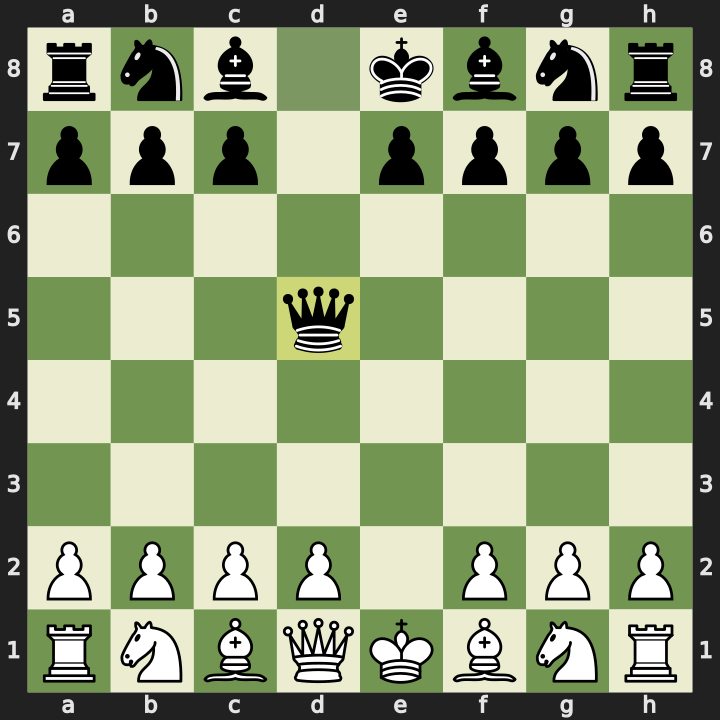
Black met 1. e4 with 1…d5, the Scandinavian. After 2. exd5 Qxd5 the queen was already sitting out in the open. I haven’t studied much about how to deal with the Scandinavian, so I fell back on general principles for early queen attacks. When your opponent brings the queen out early it becomes a target, so I tried to use it as a chance to develop pieces with tempo. 3. Nc3 developed the knight and hit the queen at the same time.
3…Qe5+
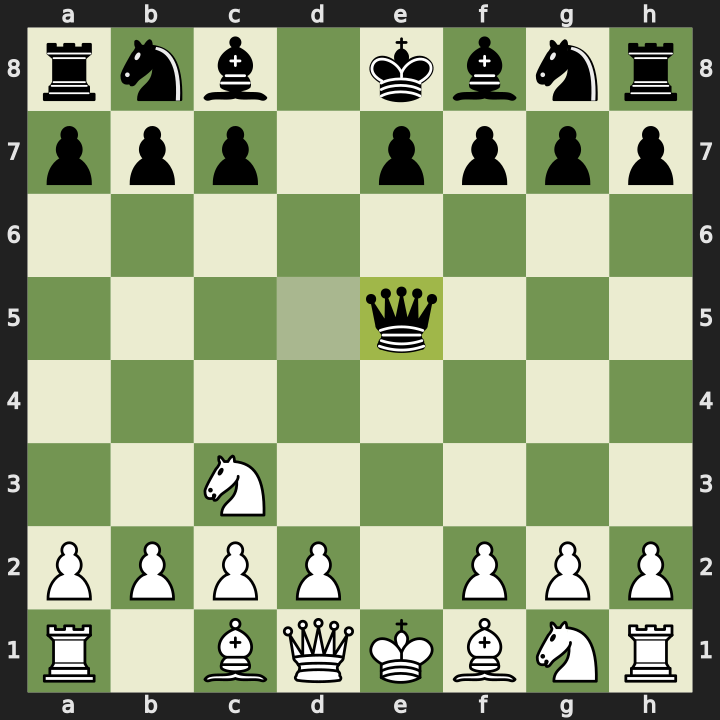
The queen went to 3…Qe5+ with check instead of stepping back.
4. Be2 Bg4 5. Nf3 Bxf3 6. gxf3
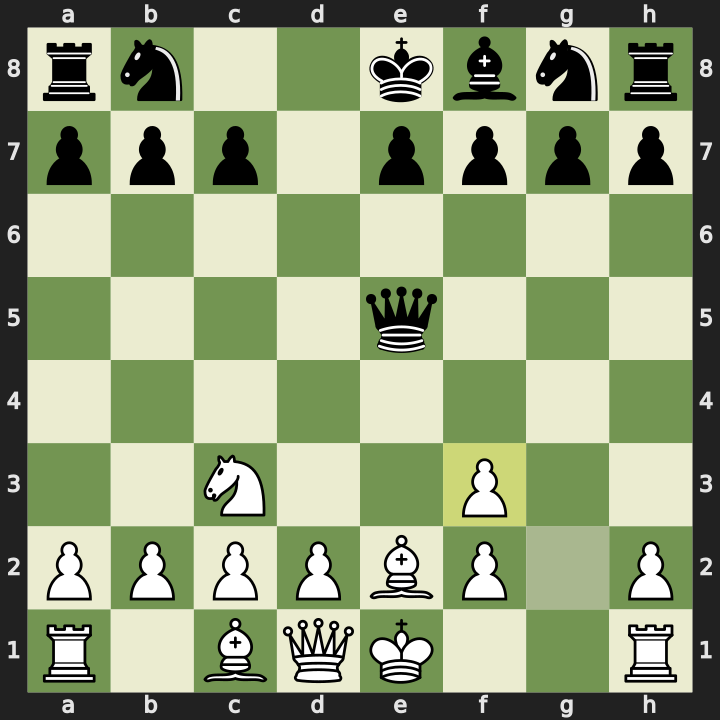
I blocked the check with 4. Be2, which also clears the way for castling later. When that bishop got hit with 4…Bg4, I developed the other knight, 5. Nf3, again with tempo against the queen. Black took the knight rather than relocate the queen, and I recaptured with the pawn, 6. gxf3. That left my e2 bishop pinned to my king by the queen down the e-file, which changes my plan a little. I’ll need to castle queenside now.
A Change of Plan (Moves 6-8)
6…e6 7. b3 Bb4 8. Bb2
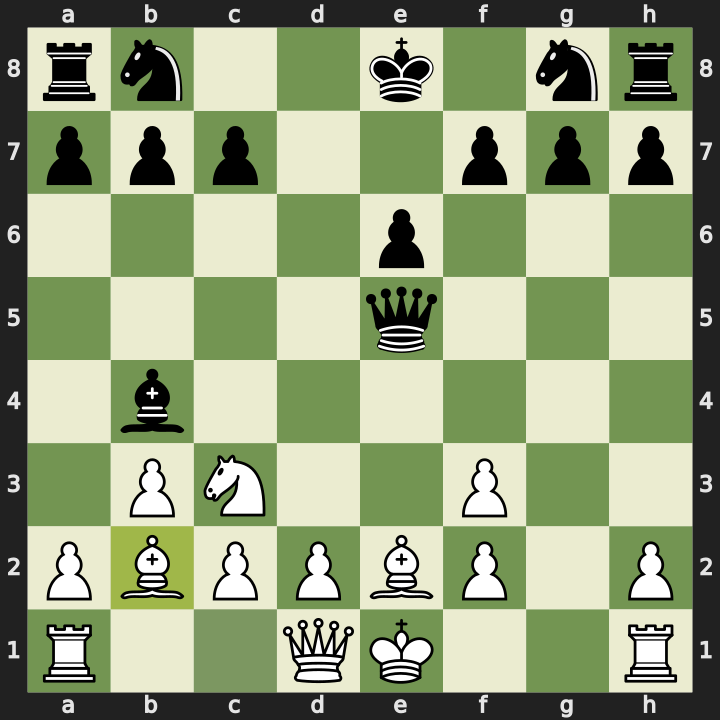
Black played 6…e6 and I turned to the fianchetto. I noticed that if I could get my bishop to b2, it would line up with the queen on e5 down the long diagonal, with my knight on c3 sitting in between, so maybe there’d be some kind of discovered attack in it later. 7. b3 prepared the square, Black developed with 7…Bb4, and 8. Bb2 put the bishop on the diagonal and got me a step closer to castling queenside.
Lining Up on e6 (Moves 8-12)
8…f6 9. d4 Qd5 10. Bc4
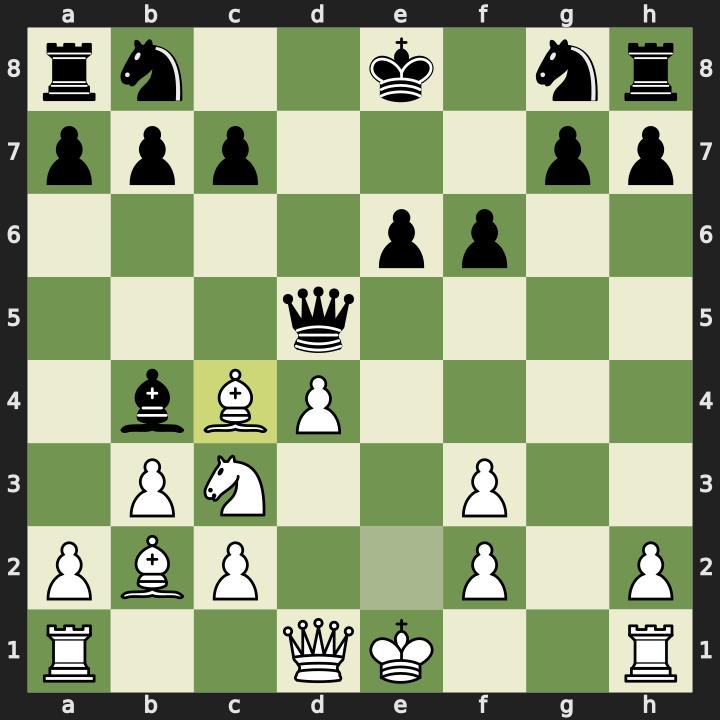
The other question was what to do with my queen. It was stuck on d1 stopping me from castling, so my plan was to get it to e2, on the same file as Black’s king. That looked especially attractive now that 8…f6 had left the e6 pawn weak. First I harassed the queen a couple more times: 9. d4 hit it, and after 9…Qd5 I played 10. Bc4, hitting it again and lining the bishop up on e6.
10…Qg5 11. Qe2 Qg2 12. Qxe6+
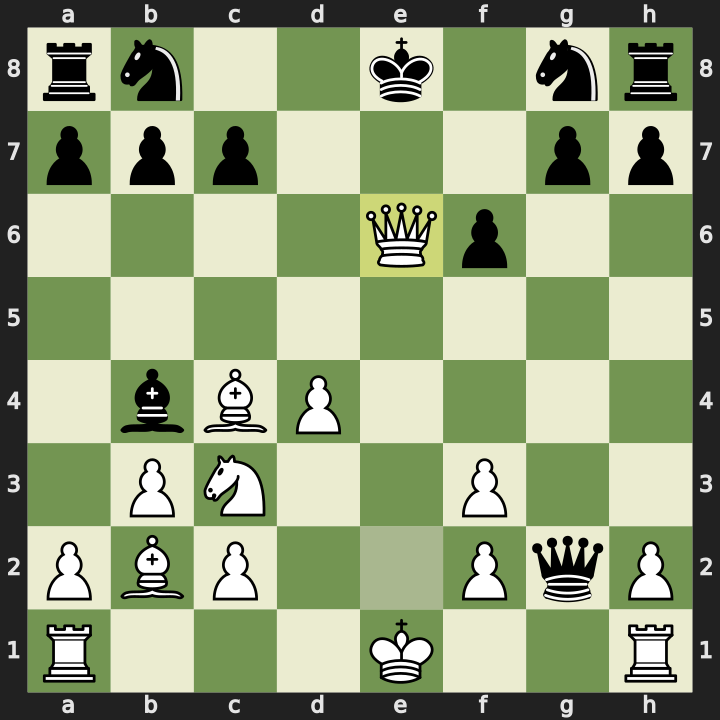
Black had to slide the queen over to 10…Qg5. It stopped me castling for the moment, but I’d achieved my secondary goal of getting both my bishop and queen trained on e6. 11. Qe2 brought the queen to the e-file, and when Black grabbed at material with 11…Qg2, hoping to pick off my rook on h1, it was too slow. 12. Qxe6+ crashed in with check.
Castling and Centralising (Moves 12-14)
12…Kd8 13. O-O-O Nh6 14. Rhe1
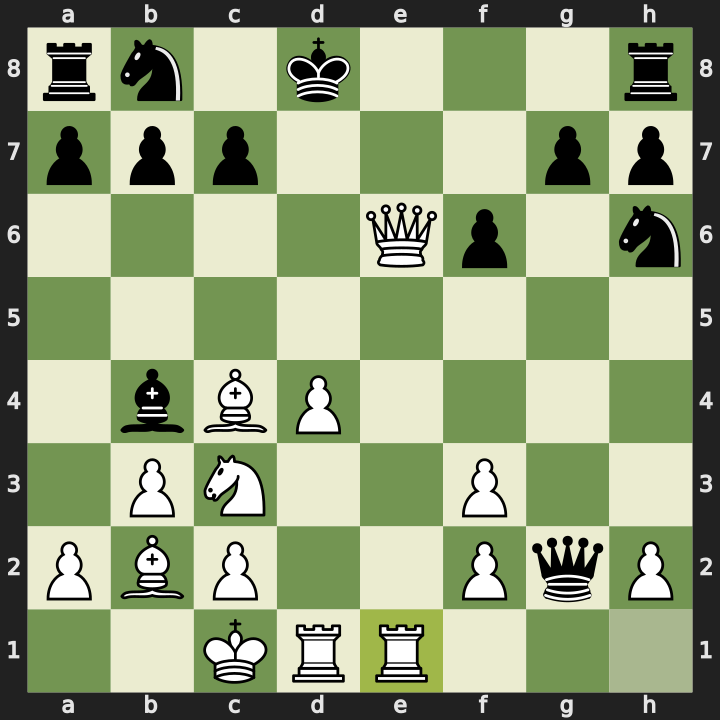
Black tucked the king to 12…Kd8, and I castled queenside with 13. O-O-O, connecting my rooks. Black’s queen could pick off a pawn on f2 or f3 if it wanted, but I had my sights set firmly on the black king. Black played 13…Nh6, presumably to give the rook some activity, and I supported my queen with 14. Rhe1, so now both rooks were in the centre. I was happy to abandon the defence of my kingside pawns because I felt like I was close to a checkmate: the light-squared bishop was well placed, I had two centralised rooks, and my own king was quite safe with a bishop and knight defending the castle.
The Trap (Moves 14-16)
14…Qxf3 15. a3
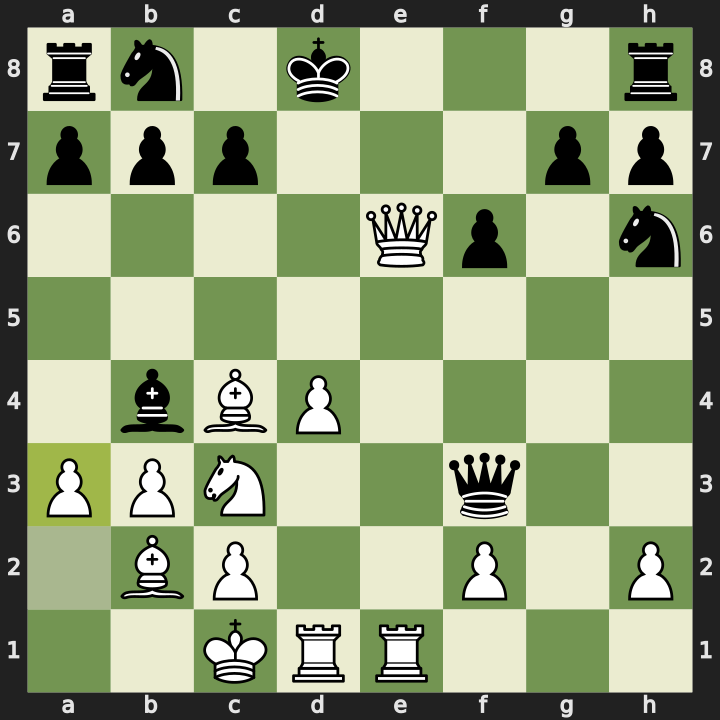
Black took the pawn with 14…Qxf3, and I played 15. a3, putting the question to the bishop on b4.
15…Bxc3 16. Qe7+
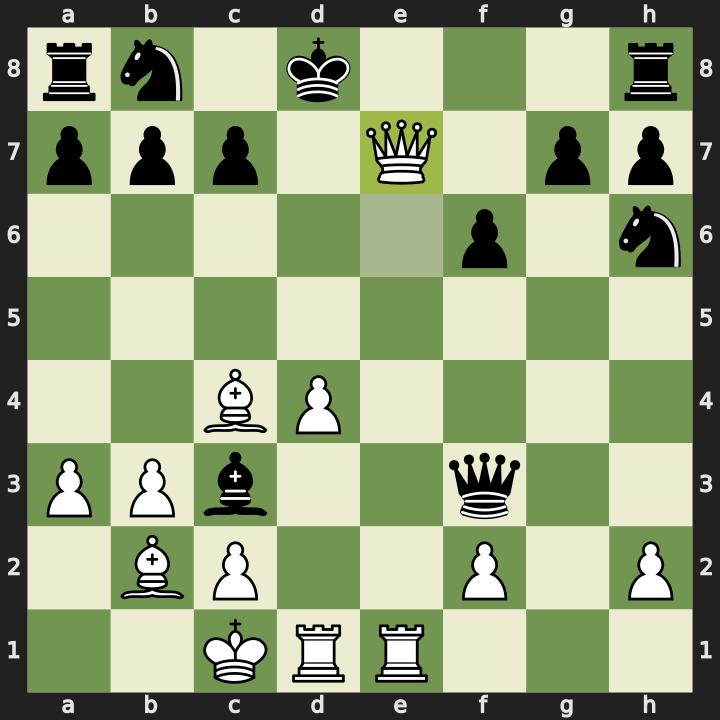
Black took the knight with 15…Bxc3. The knight only had the one defender on b2, so grabbing it looked natural. But with the bishop gone from b4, the e7 square was no longer covered, so I was free to check the king with 16. Qe7+, the queen guarded by my rook on e1. At this point Black abandoned the game.
The Mate That Was Coming
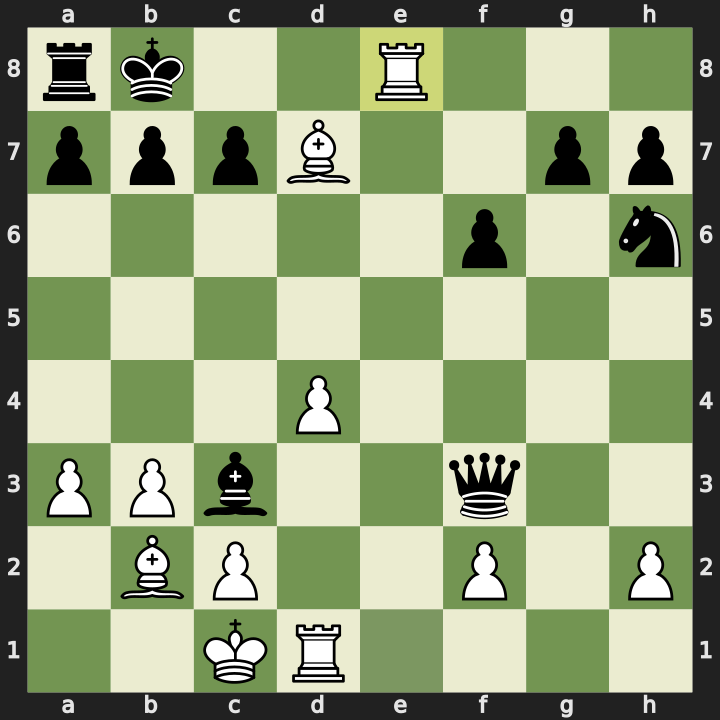
Before I looked at the engine it was already clear to me that Black was lost. From the final position there’s one legal move, 16…Kc8, and after that the finish falls into place. I play 17. Be6+, and the only reply is 17…Nd7 to block. Then 18. Bxd7+ forces 18…Kb8, and there’s a beautiful queen sacrifice: 19. Qe8+ Rxe8 20. Rxe8#.
Engine Review
This came out at 84% accuracy for me against 56.3% for my opponent, with a game rating of 1450 for me versus 400. I had no blunders and no misses, just one mistake, plus one brilliant move. Black had one blunder and two mistakes.
The mistake I made was 7. b3. The problem is that Black can bring the knight out to c6 and castle faster than I can push d4, get my queen out, and get myself castled. My plan only worked because Black made an inaccuracy with 7…Bb4, developing before focusing on their own king safety.
There was also an inaccuracy on move five when I played 5. Nf3 to attack the queen. Instead I could have played 5. d4, hitting the queen and opening a path for my dark-squared bishop, and inviting Black to exchange light-squared bishops on e2, which would again let me develop with the chance to castle kingside once the queen relocated.
The brilliant move was 15. a3. The knight on c3 was under-defended, so Black grabbed it with 15…Bxc3, and that walked straight into the mate I’d already seen: 16. Qe7+ Kc8 17. Be6+ Nd7 18. Bxd7+ Kb8 19. Qe8+ Rxe8 20. Rxe8#. That was Black’s blunder, taking the knight without spotting that the bishop was the only thing guarding e7.
Reflections
What went well:
- Playing fairly accurate moves against an opening I hadn’t really studied.
- Sticking to the principles for dealing with an early queen attack: developing with tempo against the queen every time it came out.
- Opening up the centre and going after a king that had failed to castle.
What to work on:
- Getting a bit more familiar with the Scandinavian, so I’m working from real knowledge rather than just general principles.
- Being sharper in the opening. 7. b3 was slow, and 5. d4 would have been more to the point than 5. Nf3.
Full PGN:
1. e4 d5 2. exd5 Qxd5 3. Nc3 Qe5+ 4. Be2 Bg4 5. Nf3 Bxf3 6. gxf3 e6 7. b3 Bb4 8.
Bb2 f6 9. d4 Qd5 10. Bc4 Qg5 11. Qe2 Qg2 12. Qxe6+ Kd8 13. O-O-O Nh6 14. Rhe1
Qxf3 15. a3 Bxc3 16. Qe7+ 1-0